Ian Whates is the author of ten novels (two co-written), two novellas, and over eighty short stories that have appeared in a variety of venues. In 2019 he received the Karl Edward Wagner Award from the British Fantasy Society, and his work has been shortlisted for the Philip K. Dick Award and on three occasions for BSFA Awards, while his stories have been translated into Spanish, German, Hungarian, Czech and Greek. Ian has served as a judge for the Arthur C. Clarke Award and for the World Fantasy Awards. He has served as Chair of the BSFA and, briefly, as a director of SFWA. In 2006 he founded independent publisher NewCon Press by accident. His eleventh novel, Skin Deep, is set to appear in 2027.
Reached #1 in Amazon UK science fiction Kindle sales
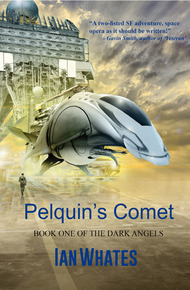
Cover by Jim Burns won the BSFA Award for Best Artwork.
In an age of exploration, the crew of the freetrader Pelquin's Comet – a rag-tag group of misfits, ex-soldiers and ex-thieves – set out to find a cache of alien technology, intent on making their fortunes; but they are not the only interested party and find themselves in a deadly race against corporate agents and hunted by the authorities. Forced to combat enemies without and within, they strive to overcome the odds under the watchful eye of an unwelcome guest: Drake, agent of the bank funding their expedition, there to oversee the bank's investment. But Drake is far more than he seems and may represent the greatest threat of all.
The inimitable Ian Whates gives us a trilogy of delightful, high-energy space adventures! – Lavie Tidhar
"Intrigue and action in this high octane collision between Firefly, the Bourne films and Indiana Jones. A two-fisted SF adventure, space opera as it should be written!"
– Gavin Smith, author of Veteran"This novel is a good, unashamed, rip-roaring piece of space opera that hits the spot… Complications, pitfalls and setbacks abound in a novel that both pays respect to and pokes fun at the conventions of its genre."
– The Financial Times"Whates' colourful tale of derring-do along the space lanes is unashamedly old-fashioned, but he's a natural story-teller and works his material with verve, obvious enjoyment, and an effortlessly breezy prose style."
– The Guardian"Pelquin's Comet is classic space opera at its finest, a satisfying and enjoyable novel in its own right and an intriguing introduction to a story universe I want to visit again. Thoroughly recommended."
– SFcrowsnest"Accessible science fiction with a thought-provoking edge…. The book is well paced and keeps your interest."
– SF Book Reviews"The universe building is deftly done and this is a tightly plotted book. Highly entertaining space opera."
– Bristol Book Log"Whates does a good job playing out the lines of suspense while steadily revealing significant plot points, keeping things character-focused, and mixing in bits of action to propel the narrative… It's a fast, fun read."
– Speculation"A devil-may-care, action-rich space opera that never lets up and never disappoints… Pelquin's Comet is great fun and utterly compelling. If you're looking for a page-turner with depth and bite, then this is for you."
– goodreads reviewerThis was Tyson Five. Federal forces had the temerity to come here, to beard the Auganics Corporation in its own lair, and the authorities were about to be taught a lesson they would never forget. A bold move, a magnificent move, to strike at the opposition's very heart; she applauded them for that, but it was also a desperate move; a do or die gambit which would likely decide the outcome of the war; for war it was, there could be no escaping the fact. This might have started out as a philosophical disagreement but it had escalated far beyond that, and the coalition oligarchs knew themselves truly challenged. If government forces failed here, their strength would be broken, their cause severely damaged if not lost. Of course, if they won…
But they wouldn't. They couldn't. The planners and schemers who sat spider-like at the corrupt heart of the bureaucratic behemoth had no idea what it was they faced on Tyson Five, or the mayhem that was about to be visited on their military, the backbone of their authority. This day the coalition would be humbled, swept aside by the full flexing of auganic might, which, for once, could be brought to bear at the same place at the same time. Human destiny was about to be rewritten.
There was no consideration of failure in any of their minds as the technologically augmented host swept into battle. The day could end only one way: in resounding victory.
So they sang their silent song, her brothers and sisters, as battle-lust coursed through their veins and excitement coloured their every thought with dreams of imminent triumph.
What the auganics shared wasn't complete gestalt; it wasn't the total sublimation of self to create a shared consciousness, a combined whole, but it was the closest thing to that state that humanity had yet achieved. Much of what made them individuals was moulded and channelled to produce unified thought, response and purpose. Leesa had come to yearn for such moments and now felt complete only when acting in concert. Yet she was still herself; immersed but not wholly subsumed.
This tight-knit sharing of thought and emotion enabled an auganic unit to react far more cohesively and effectively than even the most elite of organic troops. This cohesion combined with their other attributes made them the most formidable soldiers mankind had ever committed to the field. And they knew it. And they were reviled for it.
The authorities outlawed techorg, declaring it an abomination, and two philosophies clashed. The corporations accused the authorities of being anti-technology and anti-progress; recidivist suppressors of human evolution. The government painted the techorg companies as inhuman monsters, dispassionate meddlers in what it meant to be human. The government controlled the media and the propaganda war was lost before it had begun, but the coalition had underestimated its foe. When the authorities tried to treat this as a mere policing action their collective noses were bloodied in a dozen disastrous operations across human space. So began what amounted to civil war, though those in power preferred to use less inflammatory terms.
And now they chose to go for overkill. They had committed their full strength, to stamp out the unrest once and for all, wary lest public sympathy swung behind the auganics and their sponsors, who were being cast in the role of underdogs – ever a seductive lure for the public's conscience. Coalition forces attacked with overwhelming force, their intent obvious: to win by sheer weight of numbers if all else failed.
Leesa and her fellow auganics stood ready to welcome them.
Even so, even at the very height of the combined euphoria that swept through auganic ranks, a part of Leesa recognised that this wasn't her euphoria, her fanaticism; rather it arose from the pooling of all of them and represented the majority emotion of the many, not the one. An emotion magnified to the nth degree by the fact that it was shared. She wasn't swept away by the moment, however, not entirely. Afterwards, she would wonder whether it was this small corner of reserve that saved her.
At first everything went to plan. She remembered a heavy fire fight in which the enemy outnumbered them but didn't stand a chance. Distantly she sensed similar upwellings of triumph from other auganic units around her and in the jet fighters, singleships, and heavy ships stacked in layers above her. Not her cadre, not part of her bond group, but still her brothers and sisters. The heavens were lit by a stuttering dance of pyrotechnics, lightnings never destined to reach the ground as squadrons of nimble fighters duelled for supremacy of the air and, higher still, dreadnought pounded dreadnought with lethal energies beyond the planet's atmosphere. The whole world growled with rolling thunder and the frequent report of lethal munitions.
It was night in the part of the world she fought in; a fact that made little difference to either side but less to Leesa and hers. It meant that the skyborne conflict was all the more spectacular. She and her unit were now enjoying a rare respite after coming through several vicious skirmishes in which they had suffered light losses – a brother or sister dropping away from their communion, to be mourned properly later when time allowed. Around them stood the ruin of a recently abandoned village; ahead the village's central square. The setting made all of them uneasy, though they couldn't pinpoint why.
Without hesitation they sent in decoy drones – basic humanoid robots in battle suits, containing enough viable organic elements to register on enemy sensors, designed to imitate poorly shielded soldiers. The ploy worked. As the drones crossed the square they were caught in the crossfire of lethal energies from concealed positions and obliterated in a few spectacular seconds.
The realisation that the enemy was able to hide so effectively from their auganic senses came as a shock but they didn't hesitate, she and her fellows, falling upon the would-be ambushers without mercy. They wiped them out, suffering no further losses themselves. Only then did they pause to consider the implications. What other surprises might the coalition have in store for them? For the first time, a seed of doubt entered the collective consciousness.
The next skirmish went much the same as previous ones had, but were her brothers and sisters a little less wholehearted in their celebration? Was their subsequent advance a fraction less enthusiastic? It seemed so to Leesa. Prescience, perhaps; an inexplicable foreboding of what was to come.
And come it did.
Noise. Leesa had grown used to the external sounds of combat, from far and near, and to the internal sounds of her brethren – as comforting and constant as the love of her paternal quad – but this was something else. It started somewhere in the background, a shrill discordant whine, distant but at the same time internal. Before she had time to analyse its presence the whine had grown to become a roar, a piercing, agonising gale of almost-sound that clawed at her thoughts and shredded the fabric of auganic communion.
This was no gentle dissolution such as might occur when the unit stepped down at the end of the day and her kin became no more than a comforting background presence, but rather a violent, agonising rending; trauma as opposed to relaxation. One instant they were whole, the next torn apart. She heard her brothers' and sisters' screams and caught a hint of their suffering as they were carried away from her, before she was consumed. Fire raced through her head like molten lava, washing into every corner of thought and obliterating reason,
She was on the ground, kicking, writhing, screaming, helmet discarded as she tore at her head, her hair, trying to make the agony stop. Consciousness deserted her with the fading realisation: so this is death.
She came to in daylight, amazed to be waking at all. Sunlight bathed her face and the constant drone of flies welcomed the return to awareness. Something large flapped upward on black wings as she moved – a carrion bird. It didn't fly far, settling nearby atop a stunted tree, neck bobbing as it inspected her suspiciously.
Aside from the flies, the world seemed draped in an unnerving blanket of silence.
Leesa allowed herself to see then what she'd been trying so hard not to. She was surrounded by the dead; her slaughtered brothers and sisters, mown down by an awful and wholly unsuspected weapon of the coalition. Many of the bodies were contorted at odd angles, testament to their perishing in the throes of intense suffering. Some appeared to have clawed at their own faces, cutting open fleshy cheeks. The caked white of dried spittle and the yellower stain of vomit crusted open mouths. She took one hard long look and then averted her eyes. She strode from the scene with her gaze fixed firmly on the horizon. A cloud of black flies and blacker birds surrounded her, disturbed by her passage; her own dark bow wave as she traversed the sea of the dead.