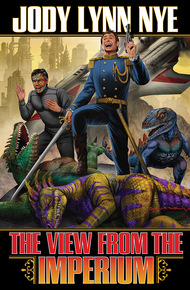
Jody Lynn Nye lists her main career activity as 'spoiling cats.' When not engaged upon this worthy occupation, she writes fantasy and science fiction books and short stories. Since 1987 she has published over 45 books and more than 150 short stories. Her newest series is the Lord Thomas Kinago books, beginning with View from the Imperium, a humorous military SF novel.
Jody lives in the northwest suburbs of Atlanta, with her husband Bill Fawcett, a writer, game designer, military historian and book packager, and a black cat, Jeremy. Check out her websites at www.jodynye.com and mythadventures.net. She is on Facebook as Jody Lynn Nye and Twitter/X @JodyLynnNye.
Jody wrote eight books with the late Robert Lynn Asprin, License Invoked, a contemporary fantasy set in New Orleans, and seven set in Asprin's Myth Adventures universe: Myth-Told Tales (anthology), Myth Alliances, Myth-Taken Identity, Class Dis-Mythed, Myth-Gotten Gains, Myth Chief, and Myth-Fortunes. Since Asprin's passing, she has published Myth-Quoted, Dragons Deal and Dragons Run (Ace Books), third and fourth in Asprin's Dragons series.
P.G. Wodehouse meets space opera as Ensign Thomas Innes Loche Kinago, fresh from the Academy is given his first command.
A crumb from the upper crust, he's eager to uphold the traditions of his family, and in particular, his mother, a distinguished Admiral of the Imperium. Of course, he's aware of the importance of always having simply smashing tailored uniforms on hand, and having his camera ready to record memorable moments for his scrapbook. In the meantime, a charismatic leader has arisen who seems able to control the minds of anyone he meets, and may be on his way to taking over the entire galaxy.
Can Kinago's aristocratic bearing and unbridled snobbery stand up to such a challenge? Fortunately, his constant companion, the unflappable Jeeves, er, Parsons, is on hand to look after the young, impulsive master, and somehow help his charge bumble his way through, perhaps even saving the galaxy in the process.
2025 Dragon Award Nominee – Best Alternate History Novel
New York Times best-selling author
USA Today best-selling author
Prologue
The ions stopped exploding off the surface of the ship as it emerged from ultra-drive and the rift in space sealed behind it. The long vessel's self-effacing dark blue shell continued to repel in glittering sparks the few microscopic particles that had previously occupied the portion of space that the ship now possessed. Four broad fins of a wedge-shaped cross-section ran the entire length of the solid tube shape. At the propulsion end, the fins widened out to form a traditional landing pattern. At the navigation end, the top was contained in a repulsor net of energy that allowed the sensors within to operate without being ripped off or irretrievably dented by space junk. Its light weapons emplacements lay in the angles. Except for the minor fireworks and the glimmer of the net, the ship Little Darling was a narrow bar of darkness across the greater darkness spangled with pinpoints of diamond light. One star stood out among the others. Portent's Star, a medium-sized blue-white, shone fiercely, its light only faintly bent into the distance by the black hole only half a light-year away that separated the rest of the Castaway Cluster from the vast Imperium. The red light of a stationary navigational warning beacon glowed like a lantern at the doorway of an ancient inn, welcoming the ship and its contingent to the system.
"Good, th'un's out there," Captain Iltekinov stated, more for the benefit of the row of distinguished visitors standing behind him on the bridge than for the crew. He received no reply. He pressed his broad back into the tattered, glossy, oxblood-colored padding of his chair and peered over his shoulder. All five of the Councillors, clad in the long yellow robes of the Yolk system, were engrossed in the row of shallow viewscreens attached to the handrails.
"When's reception return?" Ruh Pinckney, the senior diplomat, demanded. He smacked the side of the display with the flat of his hand.
A blare of sound and a blaze of light made everyone jump.
"There it is," Tam Quelph announced, pointing at her screen, as the rapid data transmission resumed. The woman peered at the time-coding running along the bottom. The backlit image threw colored lights that blurred her white-blond hair and the elaborate wave patterns of pink on her face with blobs of black, blue and white. "Damn all, we've missed over five days of discussion during the transit!"
"Y'can get archives from the First Councillor when y'land," Iltekinov growled. It wasn't the first time he had made this observation.
"We're hopelessly behind," Quelph complained. "We caught up with a more current stream, and it only shows how late we are!"
"Y'could ask 'em to stop talkin' 'til you gets there," the captain suggested. He was tired of the endless grousing and whining of the embassy from the Yolk system. An independent businessman who plied his trade among the inhabited planets and stations within the Castaway Cluster, he normally hauled cargo, mostly dry goods and produce. It all stayed quietly in its containers in the hold and didn't wear his ears out unnecessarily. He still had a whole ear on one side, but only half an ear on the other. The scar, the result of a fight in a Dree station bar over thirty years before, ran across his face to his nose, digging a ruddy furrow among the dark blue angles and crosshatches of his clan tattoos that covered his cheeks and the bridge of his nose. After thirty years and more plying the spaceways, his least favorite load was politicians. Lucky for him, a full, in-person council meeting was a rare event.
Pinckney, a heavyset man whose dark-green and yellow facial tattoos vanished into the rolls of fat under his swarthy chin, made a sound of outrage at his suggestion. "We have not been introduced to the board yet!" he said. "Our views cannot be noted until we are presented—in person—and been welcomed by the host delegation!"
"Dunno why," Iltekinov muttered to himself. "Waste of time. Traders don't bother with face-to-face. Entertainers don't bother with face-to-face. Law enforcement don't bother with face-to-face . . ."
Pinckney overheard him. "We will do these things properly, as our governments have done them for two hundred years, Captain," he said, stiffly. "Representational and in the proper order. We will have to speed-review all of the minutes taken thus far so we don't delay the others any more than we already have."
Iltekinov yawned. Once again, Pinckney was trying to blame him for their tardiness. The captain shut out the criticism. He had warned them when they'd first contacted him for passage to Portent's Star that space travel wasn't like running a light-rail system in a city. It had been too much to assume that the politicians would pay the least attention to what he'd said, let alone retain it. He was a good Yolkovian, and he had been willing to carry the negotiators to this very important conference on Dree for no other fee than fuel replenishment, in spite of the trip's interrupting his usual rounds through the Cluster.
Worse yet, the diplomats' luggage, for five human beings intending to spend less than a month in a location where food, shelter, entertainment and, if necessary, toiletries and clothing would be provided, took up almost a third of his cargo bay, making him leave behind that much of his payload on Yolk 5, also called Setria, the home planet in the system. The councillors could have made up for it by being pleasant, but no, they went on and on about how an ion storm prevented him from picking them up on the day that he had promised, as if they knew anything at all about the rigors of astrogation or physics, for that matter. How in all of nature did the five biggest complainers in the galaxy end up being named as representatives for the entire system of Yolk? He grumbled to himself and started to turn back.
The lone Wichu on the council, Ferat Urrmenoc, looked up from her screen and tipped him a sheepish grin and a wink of one of her big round eyes. The nonhumanoid with the thick, black-tipped white fur was the only one who picked up on what he was thinking. He grinned back at her and settled down in his seat.
A side screen on his personal console ran what they were seeing. The Yolkovian contingent was receiving the minutes of an extended meeting of the advisory council of the Cluster system. He had his screen muted so the transcribed text ran along the top of the image instead of playing audio into the implant in the portion of skull over his left ear. While the combined vid featured visuals, graphics and historic videos in an attempt to liven it up, the content of each learned and lengthy discourse was such boring stuff he wouldn't bother to listen to it even if he was on a fifty-year sublight haul all the way to the Core Worlds of the Imperium or the center of the Trade Union and had lost his entire collection of action shows and pornography in a database crash, and everyone in the ship he might play basketball with was in a coma, and hidden somewhere in the press of information was the directions to a planetoid full of cut jewels and wanton, willing women. The download wasn't even good for inducing sleep, since every so often one of the delegates would break into a screaming diatribe, probably out of frustration that he couldn't strangle all the others.
The Yolkovians ought to feel grateful that they had the rapid data transmission system at their disposal. True, it wasn't as satisfying as being in the room with your conversation partner, but it was a fast conveyance of information. The system had become vital during the founding of an interstellar community, and evolved greatly over the course of history as that community had evolved. The distance between two planets once meant a nine-hour gap in between sentences. Digital high dispersal transmission had shortened that to nine minutes. Once the FTL border had been broken on energy transfer, one could carry on a conversation between stars with a lag of mere hours, far better than communications carried by the first human ancestors to traverse space, but nothing ever seemed fast enough for people in a hurry. Like the council.