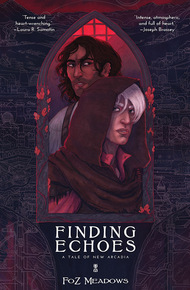
Foz Meadows is the author of SFF six novels and two novellas, most recently the Tithenai Chronicles duology, A Strange and Stubborn Endurance and All the Hidden Paths, published by Tor, and Finding Echoes, published by Neon Hemlock Press.
Foz's essays, reviews, short stories and poems have been published in venues such as Strange Horizons, Apex Magazine, Goblin Fruit and The Huffington Post, and he has won both a Hugo Award (2019) and a Ditmar Award (2017) for Best Fan Writer. His 2017 portal fantasy, An Accident of Stars, was a finalist for the Bisexual Book Awards, and in 2018, his queer Shakespearean novella Coral Bones won the Norma K. Hemming Award in the short fiction category.
Snow Kidama speaks to ghosts amongst the local gangs of Charybdis Precinct, isolated from the rest of New Arcadia by the city's ancient walls. But when his old lover, Gem—a man he thought dead—shows up in need of his services, Snow is forced to reevaluate everything. Snow and Gem must navigate not only a city on the edge of collapse, but also their feelings for each other.
The slow unfurling of relationships past and present is the core of this beautifully realized novella. Meadows's use of language is particularly well-handled, creating world and characters with surgical precision. – Catherine Lundoff and Melissa Scott
"The intricate world, grime, skullduggery, and thieves' cant of The Lies of Locke Lamora made newly intense and deliciously fraught by the emotional mastery of Foz Meadows. My heart rises, twists, and crunches precisely as they direct it to."
– Emma Mieko Candon, author of The Archive Undying"I raced through this thoroughly enjoyable book."
– Juliet Kemp, author of The City Revealed"With all the worldbuilding brilliance and political bite of Arcane, Foz Meadows's Finding Echoes will break your heart and piss you off while refusing to ever let you lose hope. I'm a bit smitten."
– Brent Lambert, author of A Necessary Chaos"Tense and heart-wrenching, Meadows' novella spins a tale of heartbreak and betrayal woven through with incisive political commentary and a meditation on the realities of addiction. Navigating a gritty world teeming with secrets and strange magics, Snow and Gem reckon with whether it's possible to mend wounds between them which run years deep—or their society's divisions, as old as the walls which defined them."
– Laura R. Samotin, author of The Sins on Their Bones"Intense, atmospheric, and full of heart."
– Joseph Brassey, author of Skyfarer and Dragon RoadThe dead boy's umbra is three days faint, shot through with red and black. It crouches in the cramped and cluttered corner of this cramped and cluttered rookery, waiting for time or a vox like me to bring it some semblance of peace. Unlike the boy himself, the umbra bears no signs of violence, no cuts or blood or bruising. Its face is clear, its clothes as neat as they ever were in life. The Kithans would have me believe that what I see here is the soul of the boy whose body lies shrouded and cold three rooms away, poor minnow, but I don't believe that. People lie, but umbras can't: they're shadows of the dead, not the dead themselves.
The umbra whimpers: a high, thin note that I alone can hear.
"Mikas?" I say, kneeling. "Mikas, can you speak?"
Behind me, Rahina stifles a sob. "You see him, Snow? You see my boy?"
"I see him."
The umbra turns its ghostly head and looks at me with wide, unseeing eyes.
"Who killed you, Mikas?" I ask it—gently, for Rahina's sake. "How did you die?"
Uncle Tavo hit me, says the umbra. He hit me and hit me. I fell down the stairs, and I stopped.
I wince. I'd guessed as much, but there's no joy in hearing it proven.
I want to know why Tavo did it, but Mikas was too young for questions about adult motives. Instead I ask, "Was he angry?"
The umbra nods. Really very.
"Do you know why he was angry?"
Another nod. The umbra shivers like horseflesh twitching away a fly, which means I've little time left. This long unfound, I'm lucky to get anything at all.
I spilled his quartz, the umbra says, hunched up with remembered fear. I didn't mean to. I'm sorry.
My throat tightens. "Don't be sorry, Mikas. It's not your fault."
The umbra looks at me, opens its mouth, and dissolves in a shudder of static. Blown away like a dandelion blossom of stars and silence.
"Well?" says Rahina, voice trembling. "What did he say?"
I don't want to tell her. She won't want to hear it. But she asked me here for a purpose, and so I must.
When I stand, I look her in the eye. She's shorter than me, though I'm hardly tall: Charybdis-born, the both of us, as underfed and undergrown as Mikas was.
"Your brother did it," I say. "Mikas spilled his quartz, and Tavo knocked him down the stairs in a rage."
Rahina shudders, grabs the wall and keens with grief. I brace her shoulder and she falls against me, thin bones pressing hard under skinny muscle.
"I took him in to spare him the mines," she wails. "And he does this?"
There's lots of things I could try to say, but none of them would help. Ever since the Assembly ruled quartz use a crime in New Arcadia, it's even less safe for addicts to get help. Most aren't violent—quartz brings pleasure and dreamy stillness, not the sparkling energy of starbright—but from the little I know of Tavo, he's always tended to anger. Maybe that's what drew him to quartz, before choice became need: to escape his own actions. The sad truth is that addicts always have reasons, but regardless of what they are, Charybdis Precinct is full of their ghosts and the ghosts of those caught between drug and user—far too many for just one vox to dispel. But I do my best. I try, though I have no temple-training; no comforting lies about souls and ascendance to offer those left with grief.
I have only the truth of the dead, and the will to speak it.
Rahina cries, and I hold her. The room in which we stand is one of two her family rents, squalid and small and three doors over from where she lives with her husband, her two remaining children, and Tavo. This room belongs to her sister-in-law, with whose children Mikas often played. Right now, they're out roaming while their mother works—too young yet to be junza-jakes, but old enough to recognise what their future holds—but their absence didn't matter to Mikas's umbra. In death, his shadow knew only that this room, where a living boy once joked and laughed, was a place of safety, and so here it came.
Umbras can tell me how their bodies died, but they don't always know they're dead. Murder victims especially, those who die in pain and fear, are prone to fleeing their corpses, trying vainly to hide from what's already killed them. It makes it harder to bring them justice, assuming there's some to be had, but the dead don't know that, and telling them changes nothing.
If I were a shield of the city or a proper Kithan acolyte, as most voxes are, I'd carry a lancet and coil to record the umbra's final testimony in a form Rahina could see and hear. Had she coin, she might even purchase a lyracite shard to hold a soundless image of her dead son, copied from my lancet's record. But this is Charybdis Precinct. Even a shard of lyracite is too lofty for someone like Rahina, while the wealth contained in a lancet and coil, if I ever acquired such tools, would paint a target on my back, regardless of junza politics. Instead, I trust that I am trusted to speak the truth, regardless of what it might cost me.
Regardless of what it costs the ones I tell.
Rahina doesn't call me a liar, doesn't ask me if I'm sure. She cries herself out against my shoulder, and when she pulls away to lead me from her sister-in-law's room, back to the rookery hall and into her own space, she does so in horrible silence.
Inside, we find Tavo right where we left him, skyed to the nines in the only available chair. Quartz has winnowed his big frame down to bone and sinew, leeching the natural colour from his hair, skin, eyes. Once, he was as brown as Rahina, good Deyosi stock; now his skin is mottled the strange, shiny grey of lead, his hair an unnatural white.
My hair is white, too, and the fingers of my left hand look dipped in silver, though I've never taken so much as a pinch of quartz. But my mother did, whoever she was, and her usage claimed me as her name never has. If Tavo ever weans himself clean, his natural colouring will likely revert, but my white-and-grey is permanent. At least the rest of me looks reasonably healthy, my skin a golden brown that's something other than Deyosi, or maybe a mix of somethings, if I guess by the mossy threads in my dark brown eyes, their single lids; the lack of curl to my hair. I don't know what I am, but I know what Tavo is.
He's not coming back from this.
Rahina stares in hopeless grief at her dead son's body, laid on the rickety table beneath a thin, patched sheet. She looks at her brother, twitching in his quartz-dreams, as oblivious to our presence as he is to his nephew's corpse.
"If I killed him for this," she asks, softly, "would you judge me?"
Perhaps I should wish that my answer was yes, but I've never been that noble. "No," I tell her.
Her fists clench. Almost, she looks like she's ready to act on it, here and now—and then she slumps, her shoulders bowing forward.
"I've no scrape to pay for burial," she says, looking back at Mikas, "and not the arms to carry him to the temple. Not alone."
She doesn't ask, but I answer anyway.
I help her lift her son.
* * *
Afterwards, my arms and shoulders aching from the unexpected labour, I meet Lark at the Hollow Star for a drink I badly need. She's already waiting, elbows propped on the cracked and greasy wood of our usual table as she nurses a pot of eyeblind. Her red hair gleams in even the dimmest light, and when she spots me, she grins, poking her tongue through the gap left by her missing front tooth.
"There he is!" she says, straightening as I seat myself opposite. "Kithani's tits, Snow, you look like curdled shit."
"I feel like it, too." I take a swallow of eyeblind, grimacing at the worse than usual burn.
Lark's face twists with sympathy. "Should I ask?"
"I'd prefer you didn't. Later, maybe."
"So noted." She taps her pot against mine. We drink together, silent against the usual grumbling chatter of the Hollow Star.
Mikas is not the first body I've carried to Ushai's temple, nor is he my first tragedy. I'm an outcast vox who talks to the dead in Charybdis Precinct: the ghosts I see belong to addicts, the elderly, to those dead of hunger and illness, to suicides and the victims of violent crime.
Most days, I can harden myself against it, but children…I don't ever want to be the sort of man who can shrug off a child's death.
I drain my pot faster than usual—faster, certainly, than I mean to. I stare at the empty cup, at a loss for what to do with it.
"Stay here," Lark says, kindly. "I'll fetch another."
I nod, not quite trusting myself to speak, and spend her brief absence mastering myself. By the time she comes back, I've determined to be better company, and prove as much by murmuring thanks when she hands me a fresh, cool pot.
"You know," she says, "if you need a break from Charybdis, I've got a job you might want to consider."
I stifle a groan. "Not another one of your fucking schemes, please—"
"Not mine, and not a scheme. Listen." She leans in, lowering her voice. "You've heard of the Red Steps?"
"Those anti-Assembly stoushers over in Argos?"
"Not just in Argos, but yeah, them." She sips her drink, brown eyes bright. "I know a fel as works with them in need of a vox's aid. He's clear desperate, Snow, and with good reason. And he can pay, too, real coin."
She pauses, waiting for my say-so. I sigh and flick my silver fingers. "All right. Tell me."
Lark grins. "Knew you'd see reason." She swigs from her pot, wipes her mouth on her hand and settles in. "So. Way this fel tells it, the Red Steps have been working sly for that progressive mawk in the Assembly, Vitho-whoever, hunting out proof the higher-ups in the Stonemetal Guild are in bed with the connexi, shilling quartz to their prison-gangs, 'cos half those crews are in for addict-crimes anyway, and they die too soon to be useful if they're taken straight off the white. Need to string 'em along a bit, yeah? Give 'em just enough to keep going, but not so much they're too skyed to work. And of course, when the guards there 'find' 'em using, they get time added to their sentences, which means more free labour and less shifts going to miners as actually earn a wage."
"Fucking goldplates," I mutter.
"Fucking goldplates," Lark agrees. "So, a noble cause. But their shattersnipe ain't come back."
I see where this is going. "So they think he's dead, and they want me to speak his umbra, find out what got him killed and why?"
"Exactly," says Lark. "Only thing is, they ain't got a body. My fel's the one tasked with finding it, and given it's been a day already and where they've got to look, he figures he needs a vox in hand or else they won't get the ghost in time."
I stare at Lark. "So, what—he wants to smuggle me into the lyracite mines to help look for a body and hope we don't get caught? That's the plan?"
"That's the plan."
"Fuck." I stare at the filthy roof and down a swallow of eyeblind. If it weren't for the city's many walls, you could see the hills that mark the mines from any decent vantage point. But the walls are older than New Arcadia: a legacy of long ago, when the city was known as Jerichae, whose denizens must've built them for a reason. Ancient history, except that it binds us still. "That's worse than one of your schemes, Lark. Signing on with the Red Steps is bad enough, but trying to fox the Stonemetal Guild for some fucking Assemblyman? If I wanted to die that badly, I'd just lie down and do it."
"Maybe so," Lark says, softly. "But time was, you wanted something to live for, too. Isn't a better city worth fighting for?"
The blow lands square as a stousher's hook. My mouth goes numb. I want to throw my drink at her, but Lark holds my gaze in a way that says she already knows I'm going to help; that she likely knew before I ever walked in.
"Gods damn you," I whisper. "Gods fucking damn you, Larkspur."
She snorts. "You don't believe in the gods."
"But you do." I pause, letting my lip curl. "Even if they haven't always returned the favour."
Now it's her turn to take a hit. She glares at me, fierce and wounded. Lark was an acolyte, once; and technically she's still temple-sworn, claimed by the Kithans in some nitpick way that lets her pass between precincts as freely as I do between junzas, but she hates to admit the particulars.
She glares at me. "I suppose I deserved that." She drains her pot, thumps it crossly on the table, then breathes in big and flashes me her scheming smile. "Well, then. Want to meet him?"
I startle. "What, now?"
"Yes, now." She pulls a face. "Lacksakes, Snow, I told you it was urgent. He wants quiet to meet, or I'dve brought him here. He's back at my stoop, waiting."
"You trust him enough to leave him there alone?"
"I trust him," Lark says, "same as I trust you." She makes a hurry-up motion, gesturing at my unfinished pot. "Let's go already!"
"And what would you have done if I'd said no?" I ask, just to be petty. I love Lark, but sometimes I hate that she knows me so well. In answer, she shoots me a withering look and mimes drinking, so I roll my eyes, finish my pot and follow her onto the street.
Late afternoon sunlight clings to the greys and browns of Charybdis Precinct like dripping treacle, making what's hard seem soft. The Hollow Star sits in the middle district, squeezed between the junza-territories of the Dark Heart and the almost-reputable squalor of the rookeries where Rahina's family lives, among so many others. I shove the thought away and focus on the present, walking quickstep alongside Lark, hood drawn up to hide my quartzborn hair. Not that I take glib for it—not here, not with so many addicts and the children of addicts going about their business—but I'm known in Charybdis, and I'd rather not be flagged down on the way to Lark's meet-see.
Lark lives in two small rooms above a mender's shop on Cant Street. She unlocks the door to the rickety inner stair with a key on her necklace, ushers me ahead of her as she locks up behind us, then pushes past on the landing to unlock her place in turn.
"In," she says, shoving me forwards.
I step inside, and see who's waiting, and freeze.
The man is my age, tall and lean-boned under hard-won muscle. His shock of black hair is loose to his scarred and stubbled jaw, looped messily behind notched ears. His black eyes widen as he sees me, brown skin going ashy-pale. It's been eight years, but I'd know him anywhere, just as surely as he knows me.
"Ushai's grace," he whispers. "Snow?"
I nod, struck dumb. I take a step forwards, as does he, until there's less than an arm's reach between us. We were the same height once, but now I only come up to his chin. I'm trembling. I want to scream or fling myself at him, I don't know which. Flee, maybe, or touch him, just to prove that he's real.
I make myself speak, and my voice comes out as wet and raw as a new-shucked oyster. "Gem?"
Lark frowns in confusion, glancing between us. "You know each other?"
"Knew," says Gem, my Gem, who is here and whole and somehow still alive. He swallows hard, hand twitching as if to reach for me, too. "I thought you were dead," he says. "I thought—"
He doesn't finish the sentence, but he doesn't need to. I know what he wants to say.
I thought I killed you.