World Fantasy, Locus, and Mythopoeic Award-winning author and poet Theodora Goss was born in Hungary, and spent her childhood in various European countries before her family moved to the United States. Goss is the author of the novel trilogy The Strange Case of the Alchemist's Daughter, European Travel for the Monstrous Gentlewoman, and The Sinister Mystery of the Mesmerizing Girl. Her short story and poetry collections include In the Forest of Forgetting, Songs for Ophelia, and Snow White Learns Witchcraft. She has been a finalist for the Nebula, Crawford, and Shirley Jackson Awards, as well as on the Tiptree Award Honor List. Goss's work has also been translated into fifteen languages. Currently, she teaches at several creative writing workshops, and in written, oral, and visual rhetoric at Boston University.

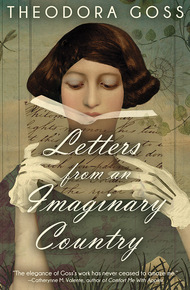
Letters From an Imaginary Country by Theodora Goss

Roam through the captivating stories of World Fantasy, Locus, and Mythopoeic Award winner Theodora Goss (the Athena Club trilogy). This themed collection of imaginary places, with three new stories, recalls Susanna Clarke's alternate Europe and the surreal metafictions of Jorge Luis Borges. Deeply influenced by the author's Hungarian childhood during the regime of the Soviet Union, each of these stories engages with storytelling and identity, including her own.

The infamous girl monsters of nineteenth-century fiction gather in London and form their own club. In the imaginary country of Thüle, characters from folklore band together to fight a dictator. An intrepid girl reporter finds the hidden land of Oz—and joins its invasion of our world. The author writes the autobiography of her alternative life and a science fiction love letter to Budapest. The White Witch conquers England with snow and silence.

CURATOR'S NOTE

A wonderful collection of haunting tales from one of the best! – Lavie Tidhar


REVIEWS

  • "Literary, lyrical, lovely. An elegant waltz through history and literature, with a fantastical turn."

    – Marie Brennan, author of The Memoirs of Lady Trent series
  • "Theodora Goss' luminous collection explores duality and liminality in identity, belonging, and setting. Goss' formidable powers as an observer and storyteller are showcased in these beautiful stories."

    – Fran Wilde, Nebula-winning author of A Catalog of Storms
  • "Alluring, unforgettable… Letters from an Imaginary Country is an invigorating short story collection that fleshes out forgotten characters and gives form to abandoned dreams."

    – Foreword
  • "Wildly imaginative, gloriously sneaky, delicious tales of monsters and the terrible and beautiful sublimity of the imagination."

    – Cory Doctorow, author of Red Team Blues and Walkaway
 

BOOK PREVIEW

Excerpt

Excerpt from "The Mad Scientists' Daughter"

In London, we formed a club. It's very exclusive. There are only six members. Five of us live on the premises. Helen, who is married, lives in Bloomsbury, but she comes to have dinner with us twice a week. We need each other. None of us has sisters, except Mary and Diana in a way, so we take the place of sisters for each other. Who else could share or sympathize with our experiences?

I. The House Near Regent's Park

Mary created a trust that holds the deed to the house. We are all listed as beneficiaries:

Miss Justine Frankenstein

Miss Catherine Moreau

Miss Beatrice Rappaccini

Miss Mary Jekyll

Miss Diana Hyde

Mrs. Arthur Meyrinck (née Helen Raymond)

But it is her house, really. Her father left it to her, along with a moderate fortune. She is the only one of us who has inherited any money. Science does not pay well; mad science pays even worse.

From that fortune, she created a fund out of which we can draw for emergencies, but we all work. Mary paints on porcelain. Justine and Beatrice embroider vestments for the church. I write potboilers for the penny press. Diana is on the music-hall stage. She can't, she says, stand the dull, ladylike sort of work the rest of us do. She must have excitement: the footlights, the greasepaint, the admirers. We don't judge. Who, indeed, are we to do so? We have all done things of which we are not proud. The club is a haven for us, a port in a particularly stormy world.

Helen does not work, of course: she has a household to run, a daughter to raise. She is also her husband's model. You might remember her as Helen Vaughan, although she also went by Herbert or Beaumont, at the time of what the newspapers called the West End Horrors. I have seen paintings of her at the Grosvenor, as Medusa with snakes for hair, or a lamia. I envy her sometimes, living in the midst of an artistic ferment, participating in the world. But then I curl up on the sofa by the fire in the clubroom, at peace with the world and myself, and think about how lucky I am to be here, out of the tumult of life, and I am content.