Excerpt
A Brief Introduction
Richard Klaw
Simians, especially the great apes, play an integral, vital role in our culture and in our collective unconscious. These creatures represent a part of humanity that must remain hidden. They can be both savage and gentle. They are much like man but they are not men. With their humanlike appearance and behaviors, it's easy to see what Darwin saw. As humanity's closest relation, how could apes not fascinate?
From Shakespeare's Tempest to Swift's Gulliver's Travels to James Fenimore Cooper's The Monikins to Edgar Allan Poe's "Murders in the Rue Morgue" through the twentieth-century tales of Edgar Rice Burroughs, Max Brand, Earle Stanley Gardner, L. Sprague de Camp, Wyndham Lewis, Rudyard Kipling, Franz Kafka, Gaston Leroux, C. S. Lewis, Michael Crichton, Pierre Boulle, Bernard Malamud, Pat Murphy, and countless others, simians infuse the literary playground. Similar influences abound in other media, especially film, as typified with the popular and culturally significant movies such as King Kong, The Planet of the Apes series, Mighty Joe Young, and the numerous Tarzan incarnations.
Surprisingly, given the simian's influential role in popular culture, only one previous anthology of ape fiction exists. Published in 1978 by Corgi, The Rivals of King Kong collected eight reprinted stories, two originals, and an excerpt from one of H. Rider Haggard's Allan Quartermain books. Editor Michel Parry contributed the introduction and checklist of simian cinema. The difficult-to-locate collectible paperback original commands a ridiculous price ranging from $30-$200.
John DeNardo, producer of the Hugo Award-winning website SF Signal, asked me to contribute to his popular Mind Meld series. This confluence of thoughts by science fiction writers, artists, editors, and critics ponders topics and themes of interest to fans of the genre. The subject this time ("If you could publish a short fiction anthology containing up to twenty-five previously published sf/f/h stories, which stories would it include and why?") enabled me to elaborate on one of the least understood and appreciated subgenres of fantastic fiction. I listed twenty-one stories all featuring apes by some of the biggest names in literature. It was a short jump to assembling this very book.
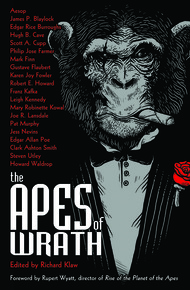
From that original list, I kept thirteen tales and added four more. The talented Gio Clairval supplied fresh translations for the Flaubert and Kafka contributions. Then using Ann and Jeff VanderMeer's extraordinary primer/anthology Steampunk as a template, I recruited fellow ape aficionados Scott A. Cupp, Mark Finn, and Jess Nevins to help me uncover the breadth of apes in pop culture and explore the simian's place in literature, comics, and film. Rupert Wyatt's marvelous foreword and the extraordinary Alex Solis cover round out this unique volume.
Despite the quality of the stories within, the authors are, at times, sadly the victims of the shallow and ignorant societal views of their time. Rather than preclude several otherwise excellent tales, I decided to include the unabridged versions, offensive beliefs and comments intact.
A brief note on the difference between apes and monkeys: While both are primates, apes do not have tails. Apes also tend to be larger and have bigger brains. Gorillas, chimpanzees, orangutans, gibbons, and even humans are classified as apes, while baboons, marmosets, and macaques are monkeys.