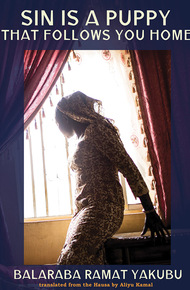
Balaraba Ramat Yakubu published her first novel in 1987, and has been one of the bestselling Hausa authors ever since. She has also written, directed and produced a number of films for Kannywood, the Hausa-language film industry based in Kano, Nigeria.

Sin Is a Puppy That Follows You Home by Balaraba Ramat Yakubu translated by Aliyu Kamal

Beginning in the late 1980s, northern Nigeria saw a boom in popular fiction written in the Hausa language.

Known as littattafan soyayya ("love literature"), the books are often inspired by Hindi films—which have been hugely popular among Hausa speakers for decades—and are primarily written by women. They have sparked a craze among young adult readers as well as a backlash from government censors and book-burning conservatives.

Sin Is a Puppy That Follows You Home is an Islamic soap opera complete with polygamous households, virtuous women, scheming harlots, and black magic.

It's the first full-length novel by a woman ever translated from Hausa to English.

And it's quite unlike anything you've ever read before.

CURATOR'S NOTE

I hope you will enjoy this fun, action-filled, polygamous, magic-wielding Islamic soap opera of life, love, and loss, from one of the best-selling authors of the genre, one which balances the form of moral folktale with settings that challenge the nature of the patriarchy upholding it. –E.D.E. Bell


REVIEWS

  • "Utterly addictive"

    – Nnedi Okorafor
  • "This is not a story of exotic Africa, nor of epochal moments in histories of colonialism and its aftermath, nor yet about the fetishized tensions of being Muslim. Instead, it is shopkeepers falling in love with women stopping to buy dress material, and mothers vacillating between the street being unsafe and being a good place to meet eligible men, and bored wives eyeing comely electricians summoned to fix the wiring. Let other books talk about purdah and polygamy; this is a book that concerns itself with soap."

    – Deepa Dharmadhikari
  • "A powerful narrative of resistance and tension not only essential to good literature but also a critical tool for the exposition of cultural politics in Nigeria, where the clash between conservative values and the modern awakening of radicalism is central to the Hausa woman's campaign."

    – Shelley Walia
 

BOOK PREVIEW

Excerpt

It had been going on like this for some time. Whenever Delu wanted to meet Alhaji Karanta, she would tell her husband some lie to get him to take her to a meeting point. Sometimes she didn't even bother with the lie and just took a taxi instead. Before long she had other lovers, too, including a young electrician whom her husband had engaged to repair an electrical fault in the house. The young man had understood how she felt about him from the looks she kept giving him. Her husband had told him to get on with the job and then left the house, asking Delu to pay him when he was finished. They had slept together, and from that day onwards, he would turn up at the house every three or four days asking if there were any more problems with the electrical wiring. She would jump up quickly the moment she heard his salaam; it was she who needed attention, not the wiring. Of course, these visits always happened when her husband was away from the house.