Born in 1980 in Lebanon, Maya Abu Al-Hayyatis an Arabic-language Palestinian novelist, poet, and children's book author. She edited The Book of Ramallah,an anthology of short stories published by Comma Press in 2021. Her children's book A Blue Pond of Questions was translated into English and published by Penny Candy Books. An English translation of her poetry appeared from Milkweed Editions under the title You Can Be the Last Leaf, translated by Fady Joudah and named a finalist for the National Book Critics Circle Award.

Born about a year after Maya, Hazem Jamjoum is a cultural historian who spends his daytimes as an audio curator and preservation archivist in London. He is an editor with the recently established publishing house Maqam Editions. His translation of Ghassan Kanafani's The Revolutionof 1936–1939 in Palestine was published by 1804 Press in 2023. No One Knows Their Blood Typeis his first literary translation. 

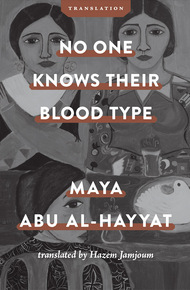
No One Knows Their Blood Type by Maya Abu Al-Hayyat translated by Hazem Jamjoum

No One Knows Their Blood Type is a novel of identity, belonging, and conflicting truths—of stories, secrets, songs, rumors, and lies. On the day that her father dies, Jumana makes a discovery about her blood type. Hers could not have been inherited from her father—the father she sometimes longed for, but always despised. This extraordinary novel centers its Palestinian narrative not on the battlefield of history, but on how women live every day in their bodies, and the colonial context of their embodied lives. With humor and exhilarating inventiveness, it asks: why aren't questions of love, friendship, parenthood, and desire at the core of our conversations about liberty and freedom? How would that transform our ideas of resistance?

CURATOR'S NOTE

Storytelling creates spaces for reflection in dimensions not offered by reality on its own. Within this short novel in story form is an exploration of the colonization of identity, told through the lens of the generational and societal trauma of women. Who are Palestinians? What is family? What are borders? Who are any of us? And whose choices are those to make? Whatever your own background, I hope that this story creates space you will find of use. –E.D.E. Bell


REVIEWS

  • "There's a remarkable coiled power to this slim novel—it moves in unexpected directions, its characters' lives tossed about by the collision of history and personality."

    – Kamila Shamsie
  • "No One Knows Their Blood Type offers a gripping, textured vision of what it can feel like to be human amidst colonial dehumanization. In this novel, the deep disruptions of war and oppression sharpen universal family complexities and prod the young Palestinian women at the novel's center to examine their own places in the world. I loved this tender, troubling book. "

    – Katharine Beutner
  • "No One Knows Their Blood Type rejects the impulse to hyper-explain Palestinian life, instead taking the reader into the inner lives of characters shaped by the exile and instability that have come to define the Palestinian condition. There are no perfect victims here. Instead, we get intimate, honest portraits of actual human beings, in their kindness and cruelty, their failure and triumph. The masterful English translation is a triumph of language over trauma. Through and through, this is a story told by Palestinians, for Palestinians. Now, more than ever, we deserve to tell our stories."

    – Eman Abdelhadi
 

BOOK PREVIEW

Excerpt

Malika, the midwife of East Jerusalem, dies. I scrub her with cheap wine. I scrub every part of her, but I can't close her half-shut eyes or stop her glance wandering off to something else. She still wants to see everything, to make sure everyone is where they're meant to be, doing what they ought to be doing. We try to do what she would have done in our place. We try and we fail. No one can be on top of everything like she always was. If she knew she'd be in a freezer until Monday she'd have thrown a fit and done everything in her power to prevent it. No one is thinking about that now; everyone is busy with the preparations. We try not to think about how it is Malika herself that we're clothing with the white socks and satin chemise she would have bought especially for a day like today.