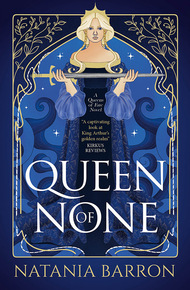
Natania Barron is an award-winning fantasy author long preoccupied with mythology, monsters, and magic. Her often historically-inspired novels are filled with lush description and vibrant characters. Publications include her 2011 debut, Pilgrim of the Sky, as well as These Marvelous Beasts, a collection of novellas.
Her shorter works have appeared in Weird Tales, EscapePod, and various anthologies, RPG, and game settings. She's also known for her #ThreadTalks, which dive deep into the unseen, and often forgotten, world of fashion history.
Barron lives in North Carolina, USA, with her family and two dogs. When she's not writing, you can find her wandering the woods, tending her garden, and collecting rocks.
Queen of None won the Manly Wade Wellman award in 2021.
"Through all the ages, and in the hearts of men, you will be forgotten."
Married at twelve, and a mother soon after, King Arthur's sister Anna did not live a young life full of promise. She bore three strong sons and delivered the kingdom of Orkney to her brother by way of her marriage. She did as she was asked, invisible and useful—for her name, her dowry, and her womb.
Now, twenty years after she left her home, Anna is summoned back to Carelon with the crown of her now-dead husband, to face the demons of her childhood: her sisters Morgen, Elaine and Morgause; Merlin and his scheming priests; and Bedevere, the man she once loved.
Carelon is changing, and Anna must change with it. New threats lurk in the shadows, and a strange power begins to awaken in her. If she is to be more than a pawn in others' plans, she must bargain her own strength, and family, in pursuit of her ambition—and revenge.
Who doesn't love an Arthurian fantasy, let alone three? Take a shot on this fantastical trilogy, which gives voice to the women behind the throne! – Lavie Tidhar
"A captivating look at the intriguing figures in King Arthur's golden realm"
– Kirkus"Barron's take will leave readers with entirely new insights into Arthurian legend."
– Booklist"Readers feel as though they could slip from the mundane to the fantastical at any moment..."
– Library Journal"A layered, engaging retelling, sure to please fans of the Arthurian tales."
– Publishers WeeklyChapter One: The Beginning of the Great End
I often picture the scene of my birth: the dark room, the pulled drapes, the stench of incense and blood. I see my father, Uther, scarred and haggard, limping across the floor, then gazing at me for a fraction of a heartbeat. He nods his acknowledgement then leaves, letting the midwives whisper in his wake.
I see my mother, Igraine, well past the flower of her youth, pale and weary. She turns her face away from me, closing her eyes with relief, knowing I could have no claim to this bloody throne. Just another daughter like all the rest. Another girl to add to the litany: Elaine, Morgen, Margawse, and now Anna.
In my mind I watch as my brother, golden Arthur, is ushered in to examine the wrinkly squalling child, his wide eyes transfixed and perhaps a little frightened, unsure what to make of the new presence making so much noise in his mother's room. He leans forward, trying to get a better look at the strange, shrieking creature. "This is your sister, Arthur," my mother says. And then he buries his head in his hands and cries. I am so ugly and small and useless, and he was hoping for a playmate. Forever his disappointment.
And lastly, and perhaps most clearly of all, I see Merlin taking me into his arms. He wasn't there before, but then, there he is, as if emerging from the walls themselves like a ghast. He leans over me, brushing his thumb over my forehead—still sticky with blood and caul—and speaks in a voice like the roaring of the sea: "Anna Briallen Carys Pendragon. Through all the ages, and in the hearts of men, you will be forgotten."
My prophecy. My burden. My curse.
This tale, not of slaying beasts and saving helpless maidens but of shaping Fate, begins shortly after the death of my first husband, Lot of Orkney. I had been away from Carelon for twenty years, having been married off at twelve, and bore my first son, Gawain, shortly after. Lot, though decidedly dead when this particular chapter of my life began, undoubtedly drained me of my worth. He leveraged Arthur's gift of our marriage and used his political power to strengthen his lands, make strategic alliances with local lords, and emerged with a house richer for it in value and in reputation. While Lot's influence grew, he kept me in the north wing of his old fortress with none but my servants, my books, and the ghasts. And once the boys were born, Lot only paraded me bout for occasions, to display Arthur's only full-blooded sister, tamed and fettered to Orkney. When he was angry, he would beat me and let me linger on the bruises. He did not love me, and he did not expect me to love him.
"There are no princesses in Orkney," he would tell me as I lay, voiceless and motionless, to his violence. "Your blood is this land's blood now."
When I returned to Carelon as a woman grown—a widow and a mother of three boys, I was weary from the month-long journey, but not broken. As we traveled the rolling hills and wheat-rich fields and away from Orkney, I thought only of seeing my son Gawain again, whom I had not seen in five years. Not even at his father's funeral. They were steely, my boys, in ways many of the other knights at court were not. Perhaps I can thank Lot for that. My children grew hard in hard places, and it did them well in the years to come. For of course this is not a happy tale. It does not end with triumph and glory, the right of things champion over the darkness: but it is memorable. It is Arthur's story, and even if you do not know my place in it, the tale remains.
I had seen the twins off at the barge in Striveling weeks before, as I rode toward Carelon: Gaheris trying to hide the tears that were both over departing from me and knowing his father was truly gone, and Gareth staunch and staid as any twelve-year-old boy can be. They were now in the care of Luwddoc, Lot's younger brother, and I hoped his similarity to Lot was comforting for the boys. I only hoped that Luw's habit of bedding any woman within ten miles would not rub off on the boys. Luw was kinder than his brother, Lot, and I trusted him to bring up his nephews in ways I could not.
Yet I had another son. My eldest. There is so little in Lot of Orkney I ever found to be of worth. From his gluttonous vices and deadly temper to his insufferable singing voice, from the bunions on his feet to the reek of his breath, everything about the man repulsed me. And yet, though conceived in grief, Lot granted me an unexpected boon: Gwalchmai, my little Gawain.
Not so little, I reminded myself. Not anymore. But he was a babe, once, and I cradled him to my breast, watched his perfect pink lips suckle greedily, and felt a joy which has since eluded me altogether. I hated Lot as I have hated anyone, but had it not been for him, I would never have borne Gawain, would never have loved as I loved him.
We crossed over the magnificent stone bridge to the north of the castle I recalled dangling my legs off of when I was a child, the rough stones ringing against our horse's hooves. I half-expected to see young Elaine, my eldest and once dearest sister, in her cloak carrying a basket of a variant of flower that only bloomed in the rain, hair plastered to her face, and smiling serenely.
I had not heard from Elaine in quite some time. Like me, she was married young in a marriage of state, given as a spoil of war, not valued for cunning mind and nurturing soul. Our last parting, bitter and brief, still lingered in my thoughts. I did wish her health and joy in my heart, even if it was hard for me to accept those things for myself. We did not often write one another, content in our separate spheres: I in the frigid North, and she in the South of Gaul.
The trees along the road to Carelon arced over us, but thinned, trimmed, and twisted into shapes more befitting of a royal garden than a natural forest. Such was the way of the world and man's unending desire to bend nature to his will. Gone was the wildness I remembered with such fondness; the thickets and brambles I had gamboled through as a child were no longer. I always pictured Carelon as a jewel in the center of a great, rugged wilderness, but now it was tamed to reflect Arthur's unending quest for rule and order. It did not surprise me. I knew the little boy arranging his soldiers in neat lines by the roaring hearth, though he stood taller now and wore a heavy crown.
It was late spring, the leaves clustered on the edges of the branches, ready to unfurl, but still cold enough to chill me down to my underpinnings. I needed some hot liquor and a fire. I felt a rattling in my chest, and a growing cough I suspected came from the long miles and terrible weather during our journey.
It was perhaps that moment, entering the outer gates of Carelon, coughing into my scarves, I at last accepted the truth: I was no longer a queen. Once, I entertained dreams of courtly love, elegance, and ruling wisely. Ten years as Lot's captive burned away those visions, naught left but ashes. Queenship, I decided, would never be my fate.
Though my relationship with Arthur was fraught on a thousand counts, I agreed, as our father before us, in the vision of a unified Braetan. A Braetan of peace. Fewer crowns means fewer conflicts, and in that a hope that Braetan could be whole—just as Avillion had been for the last three thousand years. One King, one Rule.
As Queen of Orkney, upon my husband's death, I was granted the most significant choice of my life: I could pass Lot's crown to my sons, or to my brother. Lot desired no part in unification. The few times I attempted discussion on the matter he silenced me swiftly with his fists. Instead of immediate retribution, I waited patiently. As the years went on—as lichen crept up my walls and ice filled my veins—Lot finally breathed his last. And when he gasped that final, desperate plea, naked and alone before the gods, I vowed my defiance.
So, I carried the dead King of Orkney's crown, tied around my waist in a silk and ermine lined satchel, like a weight dragging me to the bottom of a lake. Drowning in the rain, in memories, and in regret.
Certainly, I was melancholy, but who could blame me? Perhaps I expected Carelon to remain unchanged, for my familiar friends and family—Arthur, Cai, Bedevere, Elaine, Margawse, and even Morgen—to be waiting for me, preserved as if in amberglass in my absence. It was a childish, naïve wish. But it was the wish of a child who was forced to grow up far too fast, of a girl who lived in shadows so long that even a ray of sunshine through thick colored glass felt like the sun.
I had just begun to nod off again, when I heard Culver, my chief servant, at the head of my entourage, barking an order to stop. I squinted ahead and saw the red and gold banners of Arthur, and under them, two riders approaching at an impressive pace. I shivered, noticing for the first time the spires of Carelon in the distance, though misty and gray in the rain.
The riders drew closer, and after exchanged welcome and laughter—laughs I recognized but could not place immediately—the shorter rider removed her hood, and I saw it was Morgen, my half-sister. Her red lips stood out brilliantly, like a gash across her pale face, and her soot black hair fell in straight braids on either side. Morgen's face bore the same ethereal beauty, untouched since our last meeting, save the lines at the corner of her mouth and subtle hollow of her cheeks.
Morgen was ever Merlin's protected child, and it was no surprise to me the old conjuror was the other rider. I should have seen it in his gait. He turned to look at me, new streaks of white in his brown beard. His eyes were the same intense black I recalled, the lines in his face deepened and hardened but not changing the breathtaking strangeness of his face: his forehead was a twisting gyre serpentine of tattoos, his black brows bushy and unkempt, his small nose flanked by high cheekbones deeply scored with skeletal precision.
"Why, Anna, you have returned," said Morgen, upon seeing me. Her berry-green eyes bright in contrast against the drab that cloaked the world. "It is so good to see you, sister."
She was as sincere as she could be, yet I knew the words were out of courtesy rather than true compassion or feeling. My half-sister's cold affections for me were no secret. Still, I would have settled for a quiet neutrality, but the daughters of Gorlois never had seen me as an equal.
"The Queen of Orkney returns at long last," said Merlin, his voice carrying over the rain, and I shivered. I heard the words of my prophecy when he met my eyes, as fresh in my mind as new ink on parchment: Through all the ages, and in the hearts of men, you will be forgotten. "I trust the journey was not too difficult, though it was undoubtedly trying. You wear the distance on your face."
I gave the best imitation of a smile I could but felt a twinge in my lung and coughed rather unseemly into the crook of my arm.
"You're soaked through," said Morgen, bringing her horse up beside me, reaching up to touch my face. Her fingertips were like fire on my skin. "And you're burning up. How long have you been out in the open? You should be in the caravan, sister. You're not a servant."
"It is stifling in the caravan," I said, but it was not the only reason I opted for the saddle rather than cover. Anette, one of my woman servants, was recently with child, and I did not want her in such inclement conditions. So, the previous day I gave up my seat for her, and insisted the medic, Jain, stay with her; it was a small covered caravan, and certainly too cramped for three.
Instead of elaborating, however, I continued, "I am surprised to see such a greeting. I did not know if my herald arrived in time to—"
Even before I finished speaking, out of the corner of my eye I saw Culver wink at me, grimacing. I fell silent, knowing I had made an error.
Culver cleared his throat and turned the attention from Morgen's embarrassed face as he said, "Merlin and her Ladyship are on their way to greet King Pellas and his entourage—they are arriving for Lugh's Tournament. It is a happy accident we've come upon one another for such a fortuitous reunion."
"Of course," I managed, glad for the fever to cover the blush creeping into my cheeks. "You will forgive me, I have been away from court so long, and we have been preoccupied with the arrangements since Lot's passing."
Merlin narrowed his eyes, piercing, sifting through my words. Calculating. I could have done without seeing him for weeks. And here I was, not yet within sight of the castle, and the old bard was already trying to break me apart. "Yes, may his soul pass through the final door in peace," said the sorcerer.
"Yes, we wish him a swift arrival to the far shore," Morgen said, a little hurriedly. "You know, sister, Arthur will be so pleased to see you. Though you've arrived a bit earlier than we were expecting. I'm not sure Gweyn has brought everything up to her standards at the moment, what with the tournament just around the corner."
Lot had barely cooled in the crypt, it was true. But I could not wait another day in that moldering prison of a fortress.
"The winds were in our favor, it seems," I replied. Then to Culver: "We shall make do, shan't we, Culver? We can always help the Queen. It isn't as if we are unfamiliar with keeping a castle."
"Of course, Your Highness," replied the coachman.
"Her Ladyship will suffice, you recall," I said to him, and he nodded a little reluctantly. He was intentionally asserting my former title in order to remind Morgen and Merlin of whom they were dealing with, and I admired him for the pluck. They would never assume such a man as Culver, a man more at home among dung-strewn stables than at court, would ever be as capable as them. It is one of the reasons I brought him with me to Carelon.
"If you will excuse us, then," I said, letting Merlin and Morgen pass on their way. "We are tired and, as you can see, a bit worse for wear. The promise of a warm fire and a hot meal will get us these last few miles."
"Of course," Morgen said, her smile fading. "But promise me you will have your woman look after you as soon as possible. You do not look well, sister."
Merlin shook his head. "Morgen, Morgen. Your sister has plenty of attendants, and we are behind schedule. She does not need a midwife to hassle her."
I bid farewell to my sister, and watched her leave, her black braids like perfect lines down the back of her cloak. As was always the case with wise Morgen, I knew I would see her again soon. And I was curious what our next conversation, without the presence of the looming bard, would bring. There were messages in her expressions I could not put together.
The road grew busier as we approached the spires of Carelon, the towers coming into view in gilded red and yellow, and it was so much more expansive than I remembered. What had once been an impressive central fort in my childhood, the life's project of Uther Pendragon, was now a rambling collection of towers and bridges, all comprised of the same pink granite and shiny ivory limestone. A veritable city rose from its feet, inns and markets and temples and homes crouched together like penitent pilgrims.
Housed within Carelon's walls lived approximately one thousand souls at its height, only about one-tenth of whom were nobles. But that number did not take into account the city surrounding it, supported it, and supplied it. Carelon itself hosted its own brewery, winery, bakery, armory, smithy, an aviary, and extensive stables, both for the King's personal uses and the needs of the castle itself. There were forty bedrooms, and five separate apartments with two-to-three chambers in each which accommodated the King and various members of the royal family. One tower was Merlin and Morgen's, which housed the vast library below, and their elaborate quarters above. There were all kinds of wonders within, including a cloister that was, in fact, a copse of trees, a natural spring, a variety of fruit trees, and a glass-paned orchid garden. All about the castle, the stonework was a marvel of craftsmanship, depicting intertwining dragons, oak trees, and a variety of assuredly beautiful designs all in deep red and blush stone.
Yes, beautiful. Beautiful as anything made by man's hands. Perhaps Carelon was one of the greatest wonders on the face of the earth; I do not know; I have seen so little of it. But know this: such beauty came at a price, for every arc and line, every flapping banner told the story of the people who lived and died under them; the common people, the workers, the servants, unseen mothers and daughters and courtiers who do not find their way into the songs. Arthur always enjoyed decadence, as did our father Uther before him, and every inch of Carelon was steeped in grandeur. But it was a cold, drafty place in the winter, and unbearably hot in the summer months. There were more mice in the walls than people between them. The West wing was prone to flooding and then to mold and mildew by turns. One of the sewing rooms always smelled of cow manure. And not to mention, moving from one place to another in Carelon was an endless succession of stairs and hallways, no small task even for someone as accustomed to walking as I.
I am sorry there is less romance in the description. But Carelon, even glorious Carelon, was like a polished quartz embedded in the ground: if you could turn it over with your heel, all sorts of creatures would scuttle out from beneath, dark and deprived of the sun.
Culver led us down the slope and across the many bridges, through the busy streets, and into the common stables to board our horses, then arranged to send word of our arrival. I checked on Jain and Anette, and they were both well enough. Jain had come with me from Carelon to Orkney and was eager to be with her family and friends again, but Anette was born to the desolate isles to the North and was clearly nervous living among such strange folks. I tried to reassure her as well as I could, but I knew it did little good. Anette was the sort of woman who would always fret, regardless of reason.
My cough was getting worse, and at the insistence of Culver, rather than wait for an escort, I was taken through to the main entrance with Jain, Anette, and Haen—another of the groomsmen I brought with me from Orkney—for a formal announcement followed by, what I hoped, would be a swift retreat to a warm bath. It was one luxury I looked forward to at Carelon: the ease of hot water. Lot's drafty old pile of stone in Orkney contained no pipe-works to speak of, and to get enough hot water for a bath required at least an hour's notice.
We entered through the great doors, forged mostly of iron and inlaid with scrollwork, an ancient remnant of my childhood. Those doors still felt imposing, even though I had grown a bit taller. The air from inside moved my hair, bringing with it the scent of sawdust, baked bread, and musky perfume. It did not smell like the Carelon I remembered, the fortress of flux, of sweat, of hay. As a child, it was not uncommon for animals to still graze the halls. No more. It was transformed.
I was informed at the door by a knight I did not recognize that the King was not seeing anyone, let alone penitents. The knight may have said his title, but I was so incensed by his arrogant manner, and assuming I was some wandering serf, I blurted out:
"You will tell Arthur at your nearest convenience that his one true sister, Anna of Orkney, is languishing, awaiting his word," I said.
The knight looked confused and blinked at me. "You mean you're Anna?" he said.
"I realize I am slightly bedraggled, but I assure you I know my own worth," I said, removing my hand from my sleeve to reveal the twin crests of Orkney and Pendragon on my rings. They glittered rather impressively in the light. "He knows of my arrival—"
"Anna?" said a voice, as another knight approached. It was Cai, limping over to me on his bad foot, his limp so much more pronounced than I observed just five years ago when I delivered Gawain to Arthur as his squire. Now, Cai's once striking crimson hair turned to white at the temples, and one of his shoulders was significantly lower than the other. Had Arthur brought him to war again? He was immense and homely as ever, though, waxy complexion pockmarked and sallow, his squinty eyes widening as he took me in. Still, seeing him filled my heart with affection.
To the young knight, Cai said: "Gods, boy, this is the King's sister."
"But I thought His Majesty said—" attempted the knight.
"You thought what?" bellowed Cai, turning on the younger knight and squaring his shoulders. Cai may no longer have been able to compete in the tournaments or knock heads off of his enemies, but there was no doubt to his capabilities in close combat. He was strength embodied, and of such a stature I wondered, when I was younger, if he was been born of giants rather than men.
When the knight did not answer, and only blinked his dusky brown eyes, Cai asked, again, "You thought what, Sir Lamorak?"
Lamorak gulped and said, staring over my head and at the door, "I thought her Queenship—her Ladyship—was part of her retinue, and not herself. Sir."
Cai frowned, clearly disgusted by Lamorak's explanation, and rolled his eyes. "You, Lamorak, are an embarrassment. Can you not see the resemblance? Gods, man, she is as like as he is as would be a twin."
"Y-yes," stammered knight. He was shaking, beads of sweat springing out at his temple, darkening his ash blond hair. Handsome he was not, but he had a certain uniqueness to his features, a memorable face. It was the sharpness of his nose, and the distance between his eyes—not a combination I often noted.
The seneschal took a deep breath and took my arm in his, protectively. "See to it you do not forget your place, Lamorak. She has come home to us. I do not suppose you have offered her condolences for the recent loss of her husband, have you? Or informed her that her son will be brought to her as soon as possible?"
"No—no, Sir Cai, I have not," rasped Lamorak.
"Well?" He flapped his large hand in the air, his fingers as long as sausages.
Lamorak licked his lips and said, "My condolences, your Ladyship, on the loss of your husband, King Lot of Orkney. I will send word to your son—"
"Sir Gawain," interjected Cai.
"Sir Gawain," repeated Lamorak, "Ah… immediately."
"Many thanks," I said, suppressing a shiver, and squeezing Cai's arm slightly. I would have laughed save for my weary soul; Cai was always Cai, the over-protective brother I never had.
As Lamorak walked away, I said to Cai, "Must you be so hard on the poor boy?" I said it with a smile, though.
"Ah, it will help him toughen up. He needs a good scolding every now and again, truth be told. Spends much too much time impressing the lasses with his fancy title rather than earning it, I will tell you that much. A little work, and he would be a match even for your Gawain."
My heart leapt again at the mention of my son. "He is so good? Gawain, I mean."
"The best," said Cai, his face all seriousness. He was not a man to give a compliment, that was for certain.
With as much pomp and circumstance as a limping seneschal could manage, Cai walked with me through the entrance hall, asking a number of questions I could scarcely answer quick enough. He wanted to know about Gareth and Gaheris, of course, and was loath to learn they were now with Luwddoc. Cai disliked the Orkneys in general, my sons withstanding of course, and Luw even less than Lot. I believe he called him "worse than the nether bits between arse and cock" but I could be wrong.
"We are headed toward Mother's chambers…" I said, finally getting my bearings. There was so much in the way of redecoration since Gweyn arrived, from tapestries to mirrors and unfamiliar statues, I almost lost my bearings entirely. When I realized where we were at last, I came to an abrupt halt. "I—does Arthur really mean to—?"
Cai paused, a little relieved to take a breath, and looked sidelong at me. Jain and Anette waited patiently behind us, talking to each other in low voices. Anette had never seen Carelon, of course. The simple girl was out of her mind with wonder as we rushed by the dizzying delights of the castle compound.
"It is a compliment," said Cai, almost asking rather than saying. His crooked shoulders slunk. "You see—it has been entirely renovated, and awaiting, well, you. She has so put her heart into it, she would be devastated if you refused."
"She?"
"The Queen," said Cai, softly. "Gweyn. She took it upon herself to redesign the room when she knew you were coming, though it isn't quite finished in the way she'd hoped. Fresh flowers, and all."
"Fresh flowers?"
Cai nodded solemnly. "She takes the study and meaning of plants very seriously. The rest, she wanted to be a celebration of… well, you'll see. Half of the furniture is from Avillion, specially brought in, and though it is certainly not the sort of decoration I would consider a necessity to the day-in and day-out activities of one's life, I am certain you will find it—"
"Hideous," I said, barely whispering it.
Cai grimaced.
I sighed, searching, as I always did, for something comely in Cai's features. But I found none. I put my hand on his chest and spied a small golden cross pinned to his cloak, crudely made but lovely. So, the Christ men had come to Carelon. Ever-suffering Cai would be an ideal convert, but I never considered him the religious sort. Still, time changes us all. Even a man born with bloodlust and rage in his veins could be swayed toward peace and self-flagellation in the right situation.
"Ah, well, it is little matter," I finally said. "I hardly need an entire apartment. I requested something simple, but if this is what Her Majesty desires, then it will be so. So long as there is hot water, I shall be delighted."
"There is that," said Cai. "Aplenty."
"And it comes from pipes, not hauled up stairs by knock-kneed servants?"
"Every drop from the bowels of the castle," said Cai.
"And it is clear, not the muddy, murky sludge Uther used to favor?"
"On my honor, pristine as the Lake itself."
"Thank the gods," I said. "Every last one of them."