W.R. Gingell is a Tasmanian author of urban fantasy, fairy-tale retellings, and madcap science fiction who doesn't seem to be able to write a book without a body suddenly turning up. She solemnly swears that all such bodies are strictly fictional in nature.
W.R. spends her time reading, drinking a truly ridiculous amount of tea, and slouching in front of the fire to write. Like Peter Pan, she never really grew up, and is still occasionally to be found climbing trees.
Old maids! Murder! Masked Beast Lords!
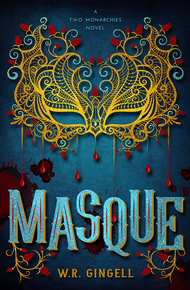
Lady Isabella Farrah didn't expect a proposal from a masked man at the Annual Ambassadorial Ball—nor did she expect a murder.
She got both.
Happily for society at large, Isabella is of the opinion that noses were made for sticking into other peoples' business, and she is delighted to do just that in the service of the murdered man—and perhaps in service of a certain Beast Lord, who is not as grateful as Isabella thinks he ought to be. Now it's just a matter of finding a murderer in a society of malcontents, traitors, and bad dancers.
It's a game of masks, and the Beast Lord isn't the only person hiding behind one…
Enter a steampunk fantasy world in Masque, where Beauty and the Beast is mixed with elements of a murder mystery—for a delightful result! It's a pleasure to have W.R. aboard, bringing her particular twist on this beloved tale. – Anthea Sharp
"I loved the dialogue. Isabella is never at a loss for just the right words for the occasion. A light, clever, and engaging fairy tale retelling that manages to be fresh and original."
– Kindle Customer"This is an amazing Beast/Beauty reimagining with a set of horrific murders mixed in for extra fun. I loved this book, and it is my favorite out of the Two Monarchies Sequence. I highly recommend you go and read the others. There are returning characters. Knowing their stories helps with some context but is not a necessity. W. R. Gingell's dialogue is absolute fire. Witty, quick, and with character introspection that drives growth and plot."
– Anna S"Masque…mixes a 19th century and modern voice with great humor throughout. All the ingredients are there for a unique murder mystery fairytale, and Gingell blends these genres together very well. The book is an inventive and funny mystery with a dynamic lead, which will make you want to pick up the next book in the series."
– Self-Publishing Review,4½ StarsThe library was pleasantly quiet when I wandered idly back through it. Someone had lit a fire in the grate, and orangey shadows flickered over the walls, pearlescent and warm. A comfortable-looking settee was set back a little from the fire, big and plush and just right for reading in, and somehow I found myself sitting down. It was comfortable, and before I knew what I was doing I had slipped out of my dancing shoes and tucked my feet beneath me as I did at home on a rainy day.
I was stretching back luxuriously with a guilty thought that I shouldn't stay too long from the ballroom, when I realised with something of a shock that I was not alone. Green eyes gazed at me from an identical chair opposite mine, and a familiar green waistcoat glowed rich emerald in the firelight: it was the man I had danced with.
"I do beg your pardon," I said, startled. It seemed ridiculous to bleat that I hadn't seen him there, since he filled the chair very obviously, his long legs stretched out in front of him; but I really hadn't seen him. "Shall I leave?"
The man stiffened, his head jerking back a little as if he were also startled, but he said quietly, "Not at all." His voice was velvet like his waistcoat, deep with slightly rough edges, but now that I had a chance to really look at him, I found that there was something unnerving in his face.
To give myself time to ruminate on the sense of unease, I said, "I'm sorry if I startled you."
He cocked his head and leaned a little forward. "Most people don't notice me when I don't want to be noticed." He said it more with interest than annoyance.
"I see," I said quietly; and I did see. I saw two things: one, that this man was a magic user, and that was why I hadn't seen him at first; and two, that my feeling of unease came from the fact that he was wearing a mask beneath a mask. The lips of it moved, but stiffly, and with imperfect synchronicity.
What sort of a man wore a mask beneath a mask? I said, "Lord Pecus, I believe?"
He laughed at that; a low, warm laugh as enthralling as his voice, and removed the green velvet mask. "You have the advantage, my lady."
"Lady Isabella Farrah," I said, inclining my head grandly, just as if I wasn't curled up in a regrettably informal way. I offered him my hand, and he kissed it in the old-fashioned way, cold porcelain against flesh. "I believe we have a mutual friend: Lady Quorn." He looked at me piercingly, and I added with mendacious helpfulness: "The one who stumbles." I was enjoying myself immensely.
I thought I saw a gleam of answering humour in Lord Pecus's eyes, but it was difficult to tell through the magical mask.
"I think I would like to see your face," he said thoughtfully. "Would it stretch politeness too far to ask you to remove your mask?"
"After you, my lord."
I thought he laughed at me, but again it was hard to tell. "I don't think I understand you, my lady."
I looked at him steadily for a moment, my chin propped up in my palm. "Forgive me if I seem rude, but I think you understand me very well."
He sat forward again, leaning his forearms on his knees. His bulk was so considerable that this manoeuvre put his face only inches from mine, and I found his eyes uncomfortably piercing. "Very well, my lady. Remove your mask, and I will remove mine."
I was burning with curiosity that was tempered by a touch of self-satisfaction that I was about to accomplish something that even Delysia had not been able to accomplish, but I untied my mask with fingers that were steady enough.
"Well, my lord?"
"Charming," he said softly, deliberately misunderstanding. I found myself blushing for the first time in many years. It was annoying to know that he'd intended as much. "How old are you, Lady Farrah?"
"Very nearly thirty, my lord," I told him composedly, ignoring the rudeness of the question. "And a confirmed old maid, so you've no need to waste your compliments on me."
"What brings you to the Ambassadorial Ball?"
"The proposed militia merger, my lord; and I believe you're stalling."
He gave me a slow, considering smile, and I wondered if the face beneath the mask was smiling also. "Is that so? Are you sure you want to see my face?"
Courtesy compelled me to say, albeit with reluctance: "Not if you're unwilling, my lord."
Lord Pecus sat silent for a moment as if in thought, his mask unreadable. "Hm. I don't believe I am," he said at last, as if he had surprised himself. "Try not to scream, my lady."
If he had said it with the slightest theatricality, I would have laughed and gone back to the ballroom, content not to know what his face really looked like. But he said it unemotionally, a plain warning; and I had to take myself firmly to task for the quickly accelerating beat of my heart as he removed the charms that kept his mask in place. I settled my chin a little more firmly in my palm and waited, watching the process with some interest. I had not much talent for magic, and my knowledge was almost as slight: my training had mostly to do with international policy and diplomatic processes.
At last he seemed to be done. He raised both hands to remove the mask—beautiful hands, strong and bare of rings—and it came away cleanly. For a moment I thought he had yet another mask beneath: firelight played on tawny brown hair—no, fur!—in a face that looked like the worst parts of wolf and bear mixed. I blinked once, realising in that instant that it was his face, his real face, and no mask. His mask must be magic indeed to have hidden that snout under the pretence of a plain common-or-garden human nose.
"I see," I said into the silent warmth of the room. I dropped my hand back to the arm of the chair and let a small sigh escape. "That explains a good deal."
Lord Pecus gave a short, startled laugh. "Does it?"
"I learned of an obscure, legendary curse in my study of Glausian history some years ago; a curse that passed from father to son."
"Not legendary," Lord Pecus said shortly. I wondered how he spoke with that snout; it didn't look suitable for human speech. More magic, perhaps? He asked briefly: "Do you find me repulsive, Lady Farrah?"
"I've seen uglier," I said coolly. "Lord Morsten, for instance. He has very unpleasant eyes, and of course he has nothing like the splendid facial hair that you do. I don't tend to look for beauty in faces."
His green eyes narrowed at me. They were the only part of his face that looked remotely human, and I found it easier to read his face if I looked into them. At the moment they were speculative, and a little sceptical. "I suppose you'll tell me that beauty is found inwardly, and that you never look at appearances."
"No, my lord. I tend to look more at shoulders. I like nice broad shoulders in a man. Many a man with an ugly face has been rendered attractive by a good set of shoulders. Besides, the courtiers with the most beautiful faces are invariably the ones who are the most inopportune." I saw that he was looking rather startled, and explained kindly: "They get spoiled, you know."
Lord Pecus threw back what I really must call his muzzle, and laughed out loud. "Lady, will you marry me?"
Many young men had said the same thing to me in jest, and I had grown adept at laughing it off with a satirical look. But when I looked into Lord Pecus' green eyes, about to do the same, I found with something of a shock that he was serious. There was no smile in his eyes, just a kind of silent intensity. So I was serious as I said: "No, my lord. I'm honoured, but my father can't do without me."
"I see." Lord Pecus' tone was thoughtful, but I saw no abatement in the determination in his eyes. Used to reading a room of courtiers at a glance, I found that this particular gleam worried me.
"Who is your father, who can't do without you?"
"The Ambassador of New Civet," I said, in the no-nonsense tone I use on the younger courtiers. I swept my feet to the floor grandly as if I had not just sat half an hour with them curled beneath me, and slipped them back into my thin dancing shoes. I fancied I saw a gleam of amusement—or was it appreciation?—in those emerald eyes of his, but chose to ignore it as the diplomat I was. "Good night, my lord. I should rejoin the dance now; my father will be wondering where I am."
Lord Pecus rose to bow, replacing his mask. It looked distinctly mechanical now that I knew what it was. "Good night, Lady Farrah. I hope we meet again."
I curtseyed with my hand on the doorknob, and said with rather more sincerity than usual: "I look forward to it, my lord."