RJ Blain suffers from a Moleskine journal obsession, a pen fixation, and a terrible tendency to pun without warning.
In her spare time, she daydreams about being a spy. Her contingency plan involves tying her best of enemies to spinning wheels and quoting James Bond villains until satisfied.
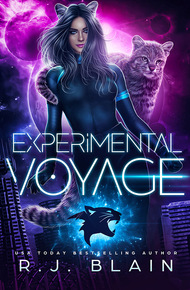
When a spaceship accident costs Camellia her chance to explore the universe as a botanist, she jumps at the chance to be a test subject on an experimental voyage. If the gamble restores her hearing, her dreams for the future will no longer be out of reach.
Venturing into the depths of space is dangerous enough, but when a shiftgem gate develops a mind of its own and yanks them into uncharted space, Camellia's skills and tolerance are tested. Her chance to explore a new world proves to be a bitter pill to swallow upon learning the truth: some discoveries are best left lost.
How can Camellia, with the help of a grumpy pilot, his cat, and his crew of space-faring predators, safeguard an entire planet incapable of protecting itself?
The answer may cost her everything, including her heart.
•A force to be reckoned with in the space opera genre, RJ Blain has a way with a lighthearted yarn. The first of her books in this bundle features one of her most badass heroines, a hybrid fox/woman named Viva who makes a living as a spacegoing scavenger. In Life-Debt, she teams up with the survivor of a shipwreck with secrets worth a fortune. The next book in the series, Experimental Voyage, stars a cat/human hybrid named Camellia who finds the challenge of a lifetime on an uncharted planet. By the time you finish reading these two books, you'll be hungry for more tales (and tails) in the series—and more adventures of any kind from this imaginative author who writes about wild journeys and battles in space as if she's lived there all her life. – Robert Jeschonek
"One of the best books I have read in a long time."
– Amazon Review"Have not read a book by this author that I haven't loved. They are interesting tales that are well written. Highly recommend."
– Amazon Review"What an enjoyable read. So much fun. I would love to read more books set in this world."
– Amazon ReviewI sat in a silent concert hall and observed the symphony play. When I'd purchased the tickets six months ago, the thought of no longer being able to hear had never crossed my mind. After the accident, everyone in my life had suggested I skip the concert. Why go when I couldn't hear the performance? Why torment myself? I'd received offers to venture to museums and other activities involving my eyes or hands rather than my ears.
Why attend something I couldn't enjoy?
I lacked an answer beyond one: I had saved for years for the box seat ticket, where I could view the performances like a bird high in the sky, surrounded by the one thing I'd loved most before fate had twisted on me.
The symphony came to the planet once every ten years, and they stayed long enough for everyone to witness their performance if they wanted. Those who couldn't afford tickets worked behind the scenes to pay for their seat in the back rows.
Instead of listening, I felt the applause as a vibration through my seat, and I took in the shifting emotions on the faces of those around me. Sometimes wonder lit their eyes, and in the moments the music took a swift turn to some darker side, apprehension and dread clawed at the audience.
Except for me.
In a way, my attendance reminded everyone, myself especially, I had already beaten the odds. I had survived what most had not. Nobody had expected a spacefaring ship to plummet to the ground, which had resulted in an explosion. Nobody had expected the crash at all.
One moment, I had been participating in a wildlife study, registering plant DNA as part of a test to see if I qualified for space adaptation genes for the purpose of venturing to some new world. The next, darkness.
As a single-planet human with ninety percent pure genetics, I would have been a willing test subject on an experimental voyage to test modern human adaptability while seeking out new life-sustaining worlds. My job would have been to study and categorize wildlife, plant and animal alike, on any planets we landed on. For our first journey, we would have gone to known planets in controlled landings. Later, we would have traveled to unexplored worlds on the edge of the explored universe.
For the following three weeks after that fateful moment, I'd clung to life in an orbiting medical clinic, a mercy ship that serviced planets lacking facilities for extreme trauma. Had I been on another world, one closer to the center of the universe, things would have been different. Even with a mercy ship heading over upon hearing news of the accident, it had been too late for me.
A shard of evolvulite remained embedded in my brain, as the mercy ship lacked the facilities needed to attempt the operation—and the places they'd consulted had given the same verdict.
Operating would kill me, where leaving the stone alone might allow me to live a long but silent life.
Somehow, the evolvulite had preserved my life. When the ship had plummeted through the atmosphere to crash into the ground, I'd been on the edge of the survival zone. As such, I held the dubious status as the one closest to the impact point to emerge from the wreckage alive. From my understanding of the situation, I should have died.
Nobody knew what to think about the crystal lodged in my head. Nobody knew what to do about it, either.
Would I die without it? Would an operation, if I could find someone bold enough to perform it, restore my hearing? For every answer the doctors found, ten more questions cropped up. As I'd beaten the odds already, every surgeon I'd inquired with refused to tackle my situation. They wanted me to keep living—even if it meant I lived without another note of music, the chiming of laughter, or the whisper of the wind through the trees.
After the concert, I would be ferried back to the mercy ship for one last appointment before they headed off to some other portion of space to do what good they could.
Once I went in for my final appointment, they could move on, waiting for the next major incident in need of a portable hospital.
Without knowing what kind of evolvulite shard resided within my skull, there were few tests anyone dared to do. Each color resonated under different circumstances. What would happen to my brain if the shard began to resonate?
The doctors admitted nobody had tried embedding a shard of the dynamic crystal deep into someone's brain, and there were no medical records indicating anyone else had survived a similar injury. Without knowing the crystal's color, their hands were tied.
Perhaps elsewhere, someone might be able to do something for me, but the mercy ship and those on board had done all they could. If I wanted more care, I would have to leave my home world without a single guarantee of success.
I appreciated their caution and refusal to gamble with my life. However, I wanted more than my memories, and the concert reaffirmed my desire and willingness to reclaim what I had lost through no fault of my own.
Without risk, I couldn't win any rewards, and until I had lost my hearing, I had not realized how important sound had been in my life. My fingers could feel a cat purr, but I would never again enjoy the soothing rumble. Dogs still barked, but I could no longer tell if the animal expressed joy or anger.
The loss of birdsong might be the one to break me. Without the peaceful morning symphonies, my days started on the wrong foot. Having to install a vibration buzzer on my bed and use a light box to jar me awake only worsened the problems for me. I adapted, but I resented my situation.
No, I resented my inability to do anything about it.
In most cases, medicine could restore lost eyesight, even for those who'd completely lost their eyes. Hearing could likewise be cured—but only in most. Medicine had progressed to the point humans could be hybridized into an entirely new species.
With one twist of fate, with one stroke of luck, both unfortunate and fortuitous, I'd become an exception.
I might change my fate and my luck, if only I could identify what color crystal lurked within my head. The doctors had informed me, using a pen and a paper at my request because it felt more personal and real, that the crystal had somehow attuned to me, sparing me from the blinding headaches and other symptoms most with foreign objects embedded in their skull endured.
I'd retained my memories. If anything, I'd become more advanced in terms of dexterity and physical strength.
One of the doctors believed I'd been given a gift.
I longed to claw free of the silent nightmare trapping me.
What use was being able to jump farther and higher? What use was there in enhanced endurance? Sound mattered, especially for the members of an exploratory team. Even humans relied on sounds to detect approaching predators, and most explorers honed all their senses to survive the harshest conditions.
Explorers adapted, however.
Even without my hearing, I would follow that same path of adaptation.
Instead of regret over what I had lost, I departed from the performance hall determined to somehow reclaim what had once been mine. I would forever remain grateful to the mercy ship and her crew, but I wanted more.
Remaining on Schwana Major would not help me. No, if I wanted to hear, if I wanted to claim my place among the stars, I would need to find a way to venture forth on my own, without the expedition force I had spent so long training to join.
I already fell behind the other survivors, who'd worked relentlessly upon recovering from the accident and mourning those who hadn't survived. A second, painful truth lingered. My presence frightened them, as I served as a reminder of what they, too, might lose if fate twisted the wrong way. Unlike them, I would need to find a new path.
And somehow, I would.