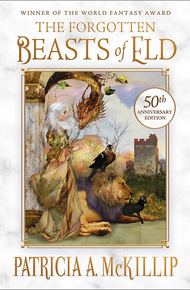
Excerpt
Introduction
by Marjorie M. Liu
Even fifty years after publication—with half a century of pop culture producing "strong" female heroes—Sybel, heroine of The Forgotten Beasts of Eld, still has not lost the ability to startle. She is a woman unashamed of her power—a woman who lacks all fear of herself and others, and whose straightforward sense of her own worth is often deployed as a weapon that disarms all who encounter her. Including the reader.
Including me.
I am supposed to write about this book that I love—perhaps my favorite book—but I have read this novel over and over, in almost every decade of my life, and as I have changed, so has the book changed in its meaning—and in my understanding of Sybel as well. It is like trying to describe why I am in love with life: there are no words, really, just a feeling in my body of radiant tenderness toward the very fact of existence.
Every time I read The Forgotten Beasts of Eld, I am filled with love, I am reminded of love, and I come away feeling loved.
That is a strange and magical power for a book to hold over someone—and I can't promise that everyone will feel the same as I do—but perhaps this love has something to do with how I was also once a girl who lived alone in the woods, with animals and books, and my craft—and little else.
And, like Sybel, I couldn't understand why I wanted nothing more than to just fly away—like magic—and never come back.
The Forgotten Beasts of Eld begins with a brief genealogy that serves to deliver us to Sybel, our heroine, but also raises more questions than it answers. Of course, if you're familiar with Patricia McKillip's books, you'll soon understand that's one of the great pleasures of her stories: there are almost always two parallel narratives—first, what is said—and then, what is unsaid. McKillip's silences are heavy. Her silences are also story.
And here, one of the powerful silences of The Forgotten Beasts of Eld belongs to the women who are Sybel's ancestors: her great-grandmother, the poor woman whom Heald coupled with; her grandmother, a fearless mountain woman of few words; and her own highborn mother, kidnapped and forced to bear a wizard's child, only to die while giving birth.
Who are they? What are their stories? What did Sybel inherit from them? After all, it isn't only magic that saves Sybel, and those around her. It isn't only power that holds her animal companions near and that gives her the wisdom and compassion to manifest her dreams.
Something else is born within her, besides magic—something not of these male wizards. Her own realization of this vast difference comes at a moment of desperation.
"So," she says. "I am never to love again. That is harsh, considering that I am the first of three wizards to learn how."
A line that always stops me cold, every time I read it: for what is unsaid, what it means, what is implied. Only three? And she is the first?
Does power corrupt so easily that there is no room for love—except in only the rarest of hearts?
Love forms the backbone of The Forgotten Beasts of Eld. Not just romantic love but love in its most generous and generative forms. But also we see again and again love's shadow-self, which exists as lust and greed.
Love, in The Forgotten Beasts of Eld, is easily mistaken for the craven desire to possess—animals, people, power—without regard for others. The cost for such abuse is high.
The cost is life itself.
A powerful riddle is repeated often within this book, for good and dire reasons: "The giant Grof was hit in one eye by a stone, and that eye turned inward so that it looked into his mind, and he died of what he saw there."
Over and over the men and women of The Forgotten Beasts of Eld, heroes and villains alike, are compelled to gaze inward and confront themselves, and do battle with their fear, pride, and hate—and their desire to possess.
Even Sybel is not immune. She inherits a tradition of possession, begun by her grandfather—calling into the family all the intelligent, magical beasts of the world—the stuff of legends. These fierce creatures do not come willingly. They are compelled to become part of a private menagerie that serves only one purpose—the self-indulgent satisfaction of simply having them.
Sybel herself is a product of such avariciousness, even as she perpetuates it as a benevolent master. Her mother, like a beast, was called and locked away—always fearful of her captor but stripped of the capacity to leave. Only when Sybel finds herself in a similar situation—possessed by another, against her will—does she slowly begin to comprehend how she herself is guilty of the same crime, and what a terrible power it is to have inhuman control over another's mind.
To say much more would spoil the book—and there is so much more I'd like to tell you—lines to be quoted, dissected for their meaning, moments savored for their beauty and truth.
But I implore you, reader, to consider love as you read The Forgotten Beasts of Eld. To consider greed, pride, hate, and fear—and how these are weapons that turn against those who wield them. Consider, too, the duality exposed through Sybel's journey—two faces, two powers—one terrifying, deadly, merciless—the other full of light, freedom, possibility. How both can be contained in the same skin. How that's worthy of love, too.
It makes me cry every time I read The Forgotten Beasts of Eld. Some old grief that hasn't yet been healed—or maybe just the ache of recognition that moves me to tears: a sympathy with Sybel. She begins in the belief that she needs no one, that she is better off alone, and how she ends—well, I won't say—except that she comes to embrace a life that her mother, her grandmother, and her great-grandmother, never had the opportunity to enjoy. A life where she is loved, fully in her power, fully inhabiting her knowing self: the conquering triumph of the voiceless, nameless women who helped create her, and whose blood runs in her veins, more powerful than any magic.
There are lessons to be learned here, there is a reason this novel still casts a spell. It is, in its own way, the kind of book a wizard might keep locked away—for what it contains are formidable lessons in how to live, as a human or being of magic. Such is the case for all of Patricia McKillip's books—she was quite the wizard herself—but I find it especially so for The Forgotten Beasts of Eld.
So, I leave you with this line: "Sometimes, in silence, at night, I hear the voices of things beyond eyesight, like echoes of ancient songs. I heard your voice, lonely in my dreams—it woke me, so I came. You see, I know how it is when you speak a name into an empty room with no one on earth to answer to it."
You have been called, reader.
I hope you find the love that waits within these pages.