James Morrow is the author of the World Fantasy Award–winning Towing Jehovah, the New York Times Notable Book Blameless in Abaddon, and the Theodore Sturgeon Award–winning Shambling Towards Hiroshima. His most recent novels include The Asylum of Dr. Caligari, The Madonna and the Starship, The Last Witchfinder—hailed by the Washington Post as "literary magic"—and The Philosopher's Apprentice, which received a rave review from Entertainment Weekly. A master of satiric and the surreal, Morrow has enjoyed comparison with Mark Twain, Kurt Vonnegut, and John Updike. He lives in State College, Pennsylvania with a collection of Lionel trains and a rapidly growing library of DVDs of questionable taste.
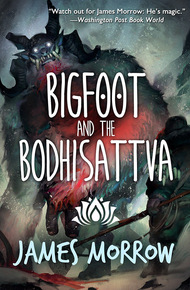
After thirty years of eating the brains of arrogant mountaineers, a James Bond-loving yeti decides that his life needs a touch more spirituality. But can an abominable monster truly change?
Thus begins an improbable journey overseen by the true Dalai Lama himself, an adventure of attempted enlightenment, dietary restriction, unlikely friendship, and political intrigue.
Bigfoot and the Bodhisattva is award-winning author James Morrow (Towing Jehovah, Shambling Towards Hiroshima) at his best: witty, incisive, and nonpareil.
After thirty years spent eating the chilled coral brains of overachieving amateur climbers who believed they could reach the summit of Mount Everest without dying, a diet from which I derived many insights into the virtues and limitations of Western thought, I decided that my life could use a touch more spirituality, and so I resolved to study Tibetan Buddhism under the tutelage of His Holiness, Chögi Gyatso, the fifteenth Dalai Lama.
The problem was not so much that I nourished myself through cerebrophagy, but that I felt so little pity for the unfortunates on whom I fed. Chögi Gyatso, by contrast, was reportedly the reincarnation of Avalokitesvara, the Bodhisattva of Compassion. Evidently he had much to teach me.
As far as I know, I was the first of my race to undertake an explicitly religious quest. Traditionally we yeti are an unchurched species. Our ideological commitments, such as they are, tend along Marxist lines, the natural inclination of any creature with a dialectical metabolism, but we try not to push it too far, lest we lapse into hypocrisy. After all, it's difficult to maintain a robust contempt for the haute bourgeoisie when their neuronal tissues are your preferred source of sustenance.
We live by a code and kill by a canon. Yes, kill: for the raw fact is that, while the typical cyanotic climber who winds up on the yeti menu may be doomed, he is not necessarily dead. We always follow protocol. Happening upon a lost and languishing mountaineer, I shall immediately search the scene for some evidence that he might survive. If I spot a Sherpa party on the horizon or a rescue helicopter in the distance, I shall continue on my way. If death appears inevitable, however, I tell the victim of my intention, then perform the venerable act of nang-duzul, hedging the frosty skull with all thirty-eight of my teeth, assuming a wide stance for maximum torque, and, finally, snaffling off the cranium in an abrupt yet respectful gesture. The sha is traditionally devoured on the spot. It's all very ritualistic, all very in nomine Patris et Fili et Spiritus Sancti, to use a phrase I learned from the left cerebral hemisphere of Michael Rafferty, former seminarian, bestselling author of eighteen Father Tertullian detective novels, and failed Everest aspirant.
No matter how scrupulously he observes the norms of nang-duzul, the celebrant cannot expect any immediate cognitive gain. He must be patient. This isn't vodka. Two or three hours will elapse before the arrival of the sha-shespah, the meat-knowledge, but it's usually worth the wait. Typically the enrichment will linger for over a year, sometimes a decade, occasionally a lifetime. Last week I partook of a tenured comparative literature professor from Princeton, hence the formality of my present diction. I would have preferred a south Jersey Mafioso to a central Jersey postmodernist, the better to tell my story quickly and colorfully, but the mob rarely comes up on the mountain. My benefactor's name was Dexter Sherwood, and he'd remitted $65,000 to an outfit called Karmic Adventures on the promise that they would get him to the summit along with six other well-heeled clients. The corporation fulfilled its half of the contract, planting Dexter Sherwood squarely atop the planet, but during the descent a freak storm arrived, and it became every man for himself. I have nothing good to say about Karmic Adventures and its rivals: Extreme Ascents, Himalayan Challenge, Rappelling to Paradise, Jomolungma or Bust. They litter the slopes with their oxygen tanks, they piss off the sky goddess, and every so often they kill a customer. My Parents Froze to Death on Everest and All I Got Was This Lousy T-Shirt.
I shall not deny that a connoisseur of long pork occupies ethically ambiguous ground, so let me offer the following proposition. If you will grant that my race is fully sentient, with all attendant rights and privileges, then we shall admit to being cannibals. True, we are Candidopithecus tibetus and you are Homo sapiens, but my younger sister Namgyal long ago demonstrated that this taxonomy is no barrier to fertile intercourse between our races, hence my half-breed niece Tencho and my mixed-blood nephew Jurmo. Do we have an understanding, O furless ones? Call us psychopaths and Dahmerists, accuse us of despoiling the dead, but spare us your stinking zoos, your lurid circuses, your ugly sideshows, your atrocious laboratories.
This agreement, of course, is purely academic, for you will never learn that we exist—not, at least, in consequence of the present text. I do not write for your amusement but for my own enlightenment. In setting down this account of my religious education, all the while imagining that my audience is your cryptic kind, I hope to make some sense of the tragedy that befell His Holiness. And when I am done, you may be sure, I shall drop the manuscript into the deepest, darkest crevasse I can find.