Frank Baker was born in London in 1908. From a young age, he had a deep interest in church music, serving as a chorister at Winchester Cathedral as a boy from 1919 to 1924. From 1924 to 1929, Baker worked as a marine insurance clerk in the City of London, an experience that he later fictionalized in The Birds (1936). He resigned in 1929 to take on secretarial work at an ecclesiastical music school where he hoped to make a career of music; during this time he also worked as a church organist.

He soon abandoned his musical studies and went to St. Just, on the west coast of Cornwall, where he became organist of the village church and lived alone in a stone cottage. It was during this time that he began writing; his first novel, The Twisted Tree, was published in 1935 by Peter Davies after nine other publishers rejected it. It was well received by critics and prompted Baker to continue writing. In 1936, he published The Birds, which sold only about 300 copies and which its author described simply as "a failure." Nonetheless, a year after the release of Alfred Hitchcock's popular film of the same name in 1963, The Birds was reissued in paperback by Panther and received new attention. Baker's most successful and enduring work was Miss Hargreaves (1940), a comic fantasy in which two young people invent a story about an elderly woman, only to find that their imagination has in fact brought her to life.

During the Second World War, Baker became an actor and toured Britain before getting married in 1943 to Kathleen Lloyd, with whom he had three children. Baker continued to write, publishing more than a dozen more books, including Mr. Allenby Loses the Way (1945), Embers (1947), My Friend the Enemy (1948) and Talk of the Devil (1956). Baker died in Cornwall of cancer in 1983.

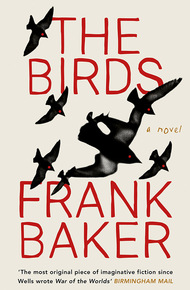
The Birds by Frank Baker

Thousands, even millions, of birds are descending on London – gathering, sitting, watching. At first their arrival is met with curiosity and amusement, as people debate where the birds have come from and what they're doing here. But soon the feathered invaders start to show their sinister side, attacking, maiming, and even killing in incidents of tremendous brutality and violence. Are they an example of nature gone horribly awry, or a paranormal manifestation? Only one thing is certain: their aim is the destruction of mankind, and nobody has any idea how to stop them . . .

Frank Baker's avian apocalypse novel The Birds (1936) went largely unnoticed when first published, but after the release of Alfred Hitchcock's film in 1963, Baker threatened to sue, believing the director had borrowed from his book. The text of this definitive edition of Baker's classic is taken from his own copy of the book, in which he made hundreds of changes and corrections, never published until now. This edition also features an introduction by Hitchcock scholar Ken Mogg.


REVIEWS

  • "The most original piece of imaginative fiction since Wells wrote The War of the Worlds."

    – Birmingham Mail
  • "Against the novels written for wholesale consumption, the fantasies of Frank Baker are an unfailing delight."

    – The New York Times
  • "The story . . . is ingenious, and succeeds in creating a sinister atmosphere."

    – Time and Tide
 

BOOK PREVIEW

Excerpt

PREFACE

"Before the birds came" was a phrase commonly used by my father. As a child I paid little attention to the words; they were but a sentence in an adult language for which I cared nothing. But once, when I had done some childish act which was forbidden—I cannot re­member what—he said to me with the humour with which he always modified his rebukes, "Anna, if you had been living before the birds came, you would have had to go to a place called a school where you would sit at a desk all day learning a number of dull things which were no use to you. So be thankful for what you have." And my mother added, "Yes, Anna. And instead of running about in the garden without any clothes as you often do, you would have had to wear ugly garments, however hot it was."

From that time my curiosity was awakened, and I began to wonder many things. Where had we all come from? Was all the world the same as I saw here—trees, fields, mountains, and cold rivers? What had my father and mother been like when they were young? Above all, what birds were those which had apparently changed life so considerably?

I asked my father these questions and many others. But he always turned away with a sigh and said, "It was too long a story. Was not the present enough without thinking of the past?"

I talked to my brothers about it, but they—being men and full of activity—did not care so much where they came from as where they were going. Their concern was with the future.

I married and left my father's home. I came back later with my three sons. My mother died. My brothers were away, married and busy with their own affairs. I found myself in daily contact with my father, more than ever I had been before.

Again I asked him, "Tell me about the birds?" And he said, "Perhaps the story should be told. But it will take a long time, Anna, and you had better write it all down as I tell it."

Between us we devised a system of what he called shorthand, so that I could write quickly while he dictated. In the month of August, while the boys were gathering in the corn harvest, my father commenced his story, and I sat at a table by his side recording every word that he spoke.